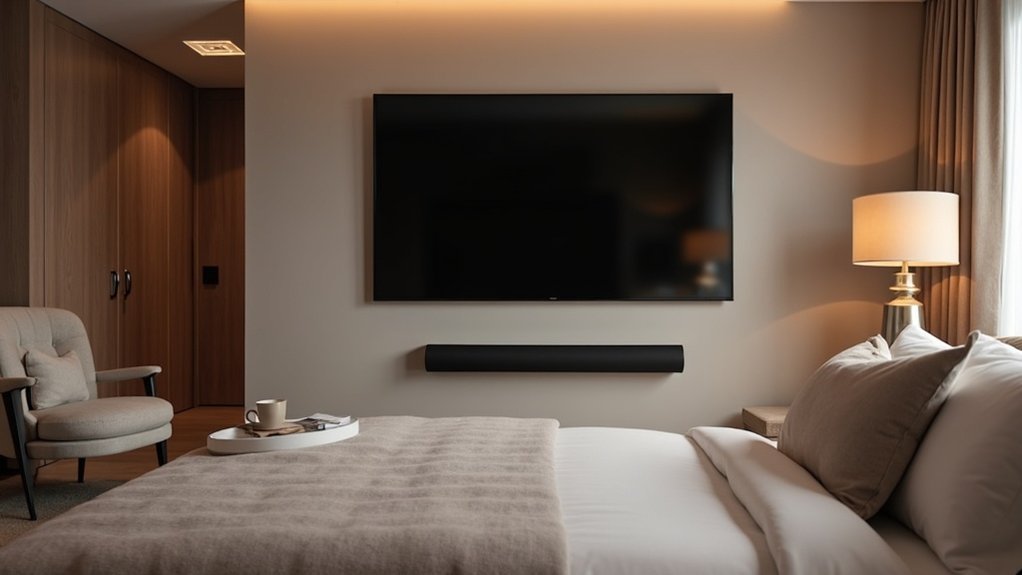
If your soundbar isn’t being detected by your TV’s ARC feature, there could be several reasons behind this issue. First, double-check your HDMI connections to ensure they are secure and that you’re using compatible cables. It’s crucial to verify that both your soundbar and TV support HDMI ARC, and make sure that CEC is enabled in the settings of both devices. Incorrect audio settings might also be causing the problem, so be sure to select the appropriate audio output for your soundbar. Power cycling both your soundbar and TV can help refresh their connections. For more troubleshooting tips specifically related to soundbars, keep reading.
Key Takeaways
- Ensure the HDMI cable is securely connected to the correct HDMI ARC ports on both the TV and soundbar for optimal performance.
- Check that both the TV and soundbar have CEC (Consumer Electronics Control) enabled, as this feature is essential for seamless communication between devices using HDMI ARC.
- Confirm that the audio output settings on the TV are correctly configured to select the soundbar as the primary audio device, ensuring you get the intended sound experience.
- Power cycle both the TV and soundbar to refresh the HDMI ARC connections, which can help establish a proper handshake between the two devices.
- Update the firmware on both the TV and soundbar to address any potential compatibility issues or software glitches that might interfere with soundbar detection.
Understanding HDMI ARC Functionality
While you might be familiar with HDMI cables primarily for video transmission, HDMI ARC (Audio Return Channel) greatly enhances your soundbar setup by allowing audio to travel both ways between your TV and soundbar using a single cable.
To utilize HDMI ARC with your soundbar, verify that your devices have an HDMI ARC Input, typically labeled for easy identification. Adjust your audio settings to select the ARC option, enabling seamless communication between your TV and soundbar.
Common Issues With HDMI ARC Detection
When your soundbar isn’t detected by the TV via HDMI ARC, it often comes down to a few common issues.
You might be experiencing cable connection problems, device compatibility issues, or settings misconfigurations.
Addressing these areas can help restore the necessary communication between your soundbar and TV.
Cable Connection Problems
If you’re having trouble with your soundbar not being detected by your TV via HDMI ARC, the issue is often related to cable connection problems.
First, ensure you’re using an HDMI port on your TV that’s specifically labeled “ARC” or “eARC,” as other ports won’t provide the necessary audio return functionality.
Next, inspect your HDMI cable connections; any loose or damaged cables can interfere with the signal. Additionally, using incompatible HDMI cables, such as standard ones instead of high-speed or eARC-compatible cables, may prevent proper communication between your devices.
After reconnecting the HDMI cable, it’s a good idea to power cycle both the TV and the soundbar, and also check for any firmware updates that could resolve potential compatibility issues.
Device Compatibility Issues
Device compatibility issues can often cause headaches when trying to connect your soundbar to your TV via HDMI ARC.
First, confirm that both your soundbar and TV support the ARC feature and that the soundbar is connected to the designated ARC port on your TV.
If detection fails, check for firmware updates on both devices, as outdated software can prevent functionality.
Additionally, using a high-speed HDMI cable that supports ARC is essential for optimal performance.
Finally, verify that your TV’s audio output settings are compatible with your soundbar, adjusting them to PCM if necessary.
Addressing these factors can help resolve connection issues effectively and enhance your overall soundbar experience.
Settings Misconfiguration
Misconfigured settings often lead to HDMI ARC detection problems that can frustrate soundbar users.
Ensure you connect your soundbar to the designated HDMI ARC-labeled port, as not all HDMI ports support ARC functionality.
In your TV’s settings, enable CEC (Consumer Electronic Control) to facilitate proper communication between your soundbar and TV.
Check your audio output settings: select the soundbar as the output device and adjust the ‘Digital Sound Out’ options for optimal compatibility.
Regularly update the firmware of both the TV and soundbar to avoid bugs and improve performance.
Finally, power cycle both devices to reset connections and encourage proper detection through HDMI ARC.
Power Cycling Your Devices
When troubleshooting issues with your soundbar failing to connect to your TV, power cycling your devices can be a simple yet effective solution.
To do this, completely shut down both the TV and soundbar, unplug them from the power source, and wait about five minutes. This process refreshes the HDMI ARC communication link, potentially resolving detection issues.
Before powering them back on, verify that the HDMI ARC cable is securely connected to the correct ARC-labeled ports.
After power cycling, turn on the TV first, followed by the soundbar, to establish a proper handshake between the devices.
Regular power cycling can help maintain the performance and connectivity of your soundbar.
Ensuring Correct HDMI ARC Connections
To ensure your soundbar connects properly to your TV via HDMI ARC, start by checking that the HDMI cable is securely plugged into the designated ARC ports on both the soundbar and the TV.
Make sure to use a high-speed HDMI cable that supports ARC functionality, as low-quality cables may cause connection issues.
Next, navigate to your TV’s input settings to verify that the correct HDMI ARC input is selected.
It’s also important to enable HDMI CEC on your TV, as this setting facilitates communication between the TV and the soundbar.
Lastly, inspect the HDMI ports for any signs of damage or debris that could interfere with the connection.
Adjusting TV Audio Settings for ARC
To ensure your soundbar is properly detected via HDMI ARC, begin by checking the audio output settings on your TV.
Next, enable HDMI CEC to facilitate seamless communication between your TV and soundbar.
Finally, ensure you’ve selected the correct ARC input to complete the soundbar setup.
Check Audio Output Settings
To ensure your TV recognizes the JBL Soundbar via HDMI ARC, start by accessing the TV’s main settings menu and checking the audio output settings.
Make sure that the JBL Soundbar is selected as the primary audio output device for HDMI ARC. Then, go to ‘Digital Sound Out’ and try different options like Auto or Pass Through.
Setting the audio output format to PCM may also improve compatibility. After making these changes, restart your TV to verify that the soundbar is properly detected and ready for use.
This step is crucial for achieving a seamless audio experience with your soundbar.
Enable HDMI CEC
Enabling HDMI CEC is crucial for ensuring your soundbar, like the JBL model, is properly detected by your TV through HDMI ARC.
To locate the HDMI CEC option, check your TV settings; this feature may be labeled differently depending on the brand, such as Anynet+ for Samsung or Bravia Sync for Sony.
Once you enable it, your TV will automatically recognize the soundbar, allowing for seamless features like power synchronization and volume control using your TV remote.
After enabling HDMI CEC, it’s recommended to restart your TV to apply the changes, which can help resolve any detection issues with soundbars connected via ARC.
Select ARC Input
Have you selected the correct ARC input on your TV?
To connect your soundbar via HDMI ARC, ensure you’re using the designated ARC HDMI port, as not all ports support this functionality.
Go to your TV’s audio settings and set your soundbar as the output device.
Check the ‘Digital Sound Out’ option, switching it to Auto or Pass Through, and try PCM for better compatibility.
Don’t forget to enable CEC in the TV settings for optimal HDMI ARC performance.
After making these adjustments, restart your TV to ensure all changes take effect and that your soundbar is recognized correctly.
Checking for Cable and Port Issues
To ensure your soundbar is properly detected by the TV, start by checking the HDMI connections and ports, as loose or incompatible setups can hinder effective communication.
Make sure the HDMI cable is securely connected to the HDMI ARC port on both devices. It’s important to verify that the cable is compatible with ARC functionality; using a high-speed HDMI cable can enhance performance.
Additionally, check that the TV’s HDMI port is labeled as “ARC,” since not all ports support this feature.
Inspect the cable for any signs of damage, as a faulty cable can disrupt the audio return channel, preventing sound from coming through your soundbar.
Enabling Consumer Electronic Control (CEC)
While troubleshooting soundbar detection issues, ensuring that Consumer Electronic Control (CEC) is enabled on your TV can greatly improve connectivity with your soundbar.
CEC allows your devices to communicate effectively, simplifying control functions and enhancing your audio experience. To make sure your soundbar is set up correctly with your TV:
- Access the TV’s settings menu.
- Locate the CEC option; it may be labeled differently (e.g., Anynet+, Bravia Sync).
- Turn it on and enable Auto Power features to streamline your setup.
- Restart your TV to apply changes.
Enabling CEC is essential for HDMI ARC functionality, as it allows audio signals to be sent back to your soundbar.
This feature also enables you to control your soundbar’s functions using a single remote, making your home theater experience more seamless.
Updating Firmware and Software for Compatibility
After confirming that CEC is enabled, the next step in troubleshooting soundbar detection is updating the firmware and software on both your soundbar and TV.
Keeping these updates current resolves potential software glitches that could hinder soundbar performance and audio functionality. Visit the manufacturer’s website to check for the latest firmware versions for your soundbar.
Most soundbars also allow you to easily check for software updates via their apps or websites. Regularly updating firmware can prevent unexpected failures in HDMI ARC and facilitate seamless communication between your soundbar and any connected devices.