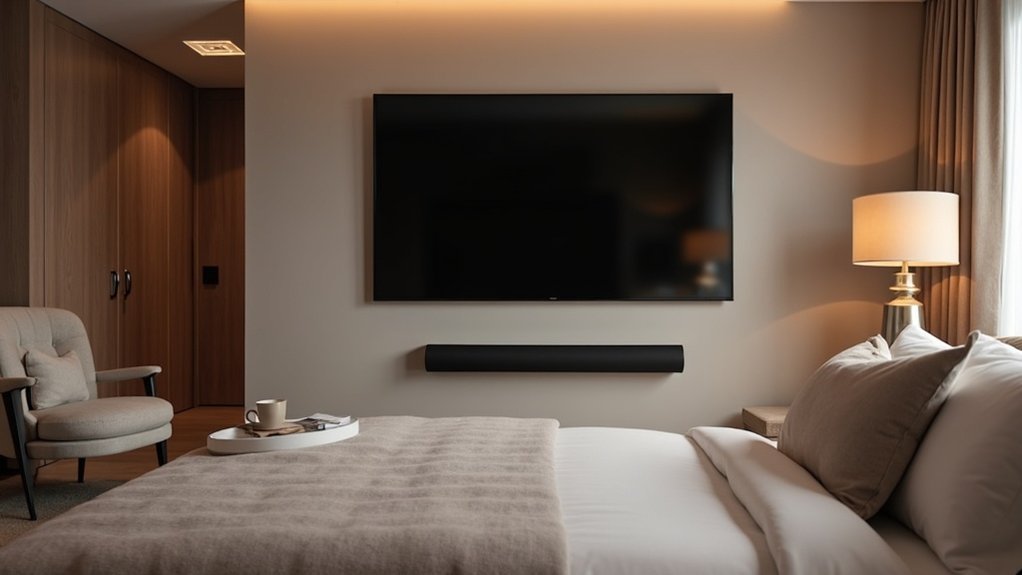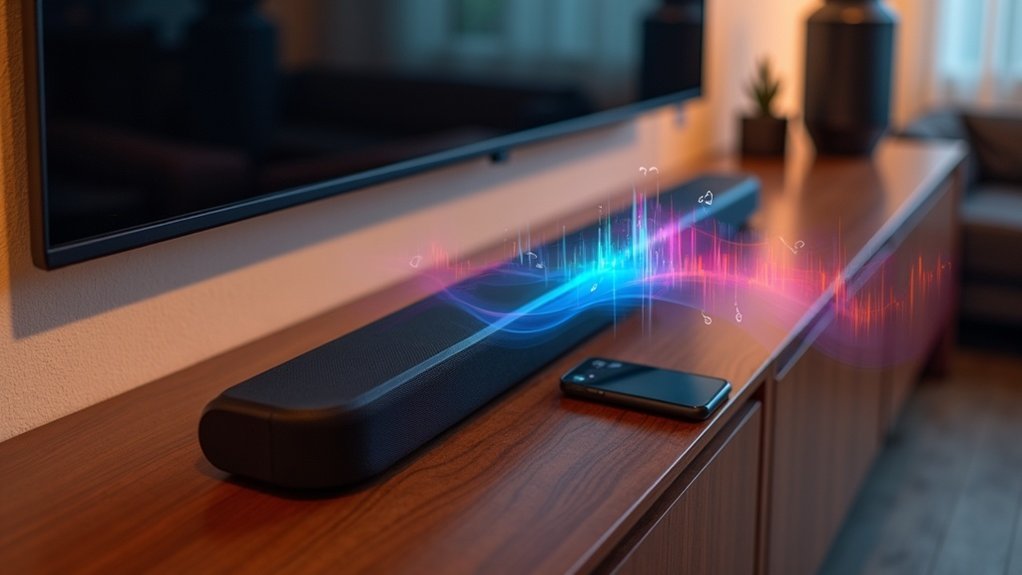
To test the frequency response of your soundbar, you’ll need a calibrated microphone, ideally a directional condenser one, and software like REW for analysis. Set up in a controlled environment, placing the soundbar at ear level and the microphone 4-6 feet away. Use pink noise or frequency sweeps for measurement, focusing on gated SPL techniques to minimize reflections. Analyzing the results will reveal peaks and dips, helping you fine-tune your soundbar’s audio experience. Discover additional tips on optimizing your soundbar setup for better performance.
Key Takeaways
- Set up a calibrated microphone at ear level, 4-6 feet from the soundbar for accurate measurements.
- Use REW software or spectrum analyzer apps to visualize the sound frequency response of your soundbar.
- Play pink noise or frequency sweeps to analyze the soundbar’s performance across the frequency range.
- Implement gated SPL techniques to isolate direct sound and reduce room reflections in your measurements for the soundbar.
- Average results from multiple positions to gain a comprehensive understanding of your soundbar’s frequency response.
Required Equipment for Testing
To accurately test the frequency response of a soundbar, you’ll need specific equipment that guarantees reliable measurements. A calibrated microphone, such as a directional condenser microphone, is essential for precise sound pressure measurement.
Additionally, software like REW (Room EQ Wizard) is invaluable for analyzing and visualizing frequency response data. For quick checks, consider using a smartphone with a spectrum analyzer app as a cost-effective alternative.
It’s important to conduct your measurements in an anechoic chamber or ensure that the soundbar is positioned away from reflective surfaces to minimize acoustic interference. This setup will allow you to effectively measure the frequency response of your soundbar and assess its performance.
Setting Up the Measurement Environment
Creating an ideal measurement environment is essential for accurately evaluating a soundbar’s frequency response. Choose a small, controlled room, ideally measuring 10’x11’x8′, and arrange furniture to minimize reflections. Position the soundbar at ear level and place the microphone at the main listening position, 4-6 feet away. To further reduce reflections, consider using acoustic treatments such as duvets or cushions. If feasible, conducting measurements outdoors can yield the most accurate results. Implement gated measurements with software like ARTA to exclude unwanted reflections and capture a clearer impulse response.
| Measurement Environment | Positioning | Acoustic Treatment |
|---|---|---|
| Small, controlled room | Soundbar at ear level | Duvets or cushions |
| 10’x11’x8′ dimensions | Microphone 4-6 feet away | Minimize wall reflections |
| Outdoors (if possible) | Main listening position | Improved accuracy |
Performing the Frequency Response Test
When testing the frequency response of a soundbar, positioning a calibrated microphone at the main listening position—ideally 4-6 feet away—ensures accurate sound capture across the frequency spectrum.
Follow these steps to measure the frequency response effectively:
- Use RTA software, like REW, to visualize audio output specific to soundbars.
- Play pink noise or frequency sweeps for extensive analysis of the soundbar’s performance.
- Implement gated SPL techniques to isolate direct sound from the soundbar and minimize reflections.
- For low frequencies, place the microphone near the subwoofer driver (if applicable) to assess bass performance accurately.
Document multiple positions and average results for a thorough understanding of your soundbar’s capabilities and sound quality.
Analyzing the Results
As you analyze the frequency response results of your soundbar, focus on the measurements captured at your main listening position, which provide the most accurate representation of its performance.
Gated measurements isolate direct sound, minimizing room reflections for clearer data.
Gated measurements focus on direct sound, reducing room reflections for enhanced clarity in audio analysis.
Compare your frequency response curves to standard reference curves to assess how well the soundbar reproduces bass, midrange, and treble.
Look for significant peaks or dips, as these indicate potential resonance or cancellation issues affecting sound quality.
Finally, averaging measurements from multiple positions gives a thorough view of the soundbar’s performance, accounting for variable room acoustics.
Tips for Accurate Measurements
Accurate frequency response measurements are essential for evaluating a soundbar’s performance, and several key practices can enhance your testing process.
Follow these tips for ideal results:
- Position a calibrated microphone 4-6 feet from the soundbar to capture accurate audio.
- Use gated SPL measurements to eliminate reflections from walls and furniture.
- Test with pink noise to guarantee a consistent frequency range across the soundbar’s operational spectrum.
- Conduct tests in a controlled environment to minimize room mode interference.
Employ software like REW to analyze your data, providing insights for sound quality adjustments specific to soundbars.