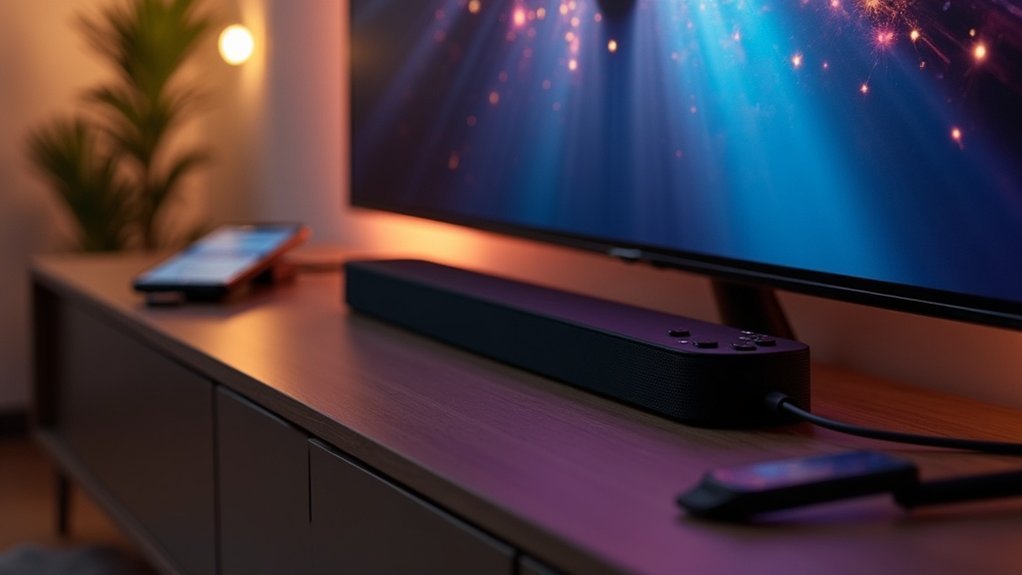
To test if eARC is functioning properly on your soundbar, begin by verifying that both your soundbar and TV support eARC and are connected using a compatible HDMI cable to the designated eARC port. Next, navigate to your TV’s settings menu to enable eARC, ensuring the sound output is set to HDMI eARC. Play media that features advanced audio formats, such as Dolby Atmos, to confirm that sound is being transmitted through the soundbar. If you encounter any issues, consider exploring additional troubleshooting steps to resolve them.
Key Takeaways
- Ensure both the soundbar and TV are connected to the eARC HDMI port using a compatible HDMI cable for accurate audio transmission.
- Confirm that eARC Mode is enabled in the TV settings under External Device Manager to activate enhanced audio features for your soundbar.
- Select HDMI ARC/eARC as the primary audio output in the TV’s sound settings and adjust to “Auto” for optimal performance with your soundbar.
- Test various media sources that support high-definition audio formats like Dolby Atmos to confirm sound transmission through the soundbar.
- If issues arise, check for firmware updates for both the soundbar and TV, and ensure secure HDMI connections are intact for a seamless audio experience.
Check Earc Compatibility
How can you ensure your soundbar and TV are ready for eARC?
First, confirm that both devices support the eARC feature, which is typically found in HDMI 2.1 devices.
Ensure both your soundbar and TV support eARC, usually available in HDMI 2.1 devices.
Next, make sure you’re using an eARC-compatible HDMI cable, such as HEAC or HEC, as standard HDMI cables may not handle the required bandwidth.
Be sure to connect to the specific HDMI port labeled “eARC” on both devices, since not all ports offer this functionality.
Finally, verify compatibility with advanced audio formats like DTS Master, Dolby TrueHD, and Dolby Atmos by consulting the manufacturer’s specifications or user manual for both your soundbar and TV.
Connect the Soundbar Properly
To connect your soundbar properly, begin by plugging it into the HDMI port on your TV that is specifically labeled as “eARC” or “ARC.” This connection is crucial for achieving outstanding audio transmission. Utilize a compatible HDMI cable, such as HEAC or HEC, to ensure optimal performance.
| Feature | Requirement | Action Needed |
|---|---|---|
| HDMI Connection Type | eARC or ARC | Connect soundbar |
| Cable Compatibility | HEAC or HEC | Use appropriate cable |
| TV Setting | HDMI eARC Mode | Activate in settings |
| Device Integration | Anynet+ (HDMI-CEC) | Enable in settings |
| Audio Output | HDMI ARC/eARC | Select in sound menu |
Be sure to verify each aspect for a seamless audio experience.
Enable Earc Settings on TV
Before enjoying the enhanced audio quality that eARC provides with your soundbar, you need to enable the eARC settings on your TV.
Follow these steps to guarantee peak performance:
- Navigate to the Settings menu and find the External Device Manager.
- Activate Anynet+ (HDMI-CEC) for better control over your soundbar.
- Set HDMI eARC Mode to “On,” as it defaults to “Off.”
- Verify that your TV connects to an eARC-compatible HDMI port and use an eARC-capable HDMI cable for the best audio experience with your soundbar.
Set Audio Output to Soundbar
To set the audio output to your soundbar, navigate to your TV’s sound settings and choose HDMI ARC/eARC as the primary output.
For optimal performance across different audio formats, adjust the sound settings to “Auto.”
After configuration, test your setup by playing various media sources to ensure sound is properly transmitted through the soundbar.
Enjoy an enhanced audio experience!
Select HDMI ARC Output
Selecting the HDMI ARC output on your TV is essential for routing audio through your soundbar. Follow these steps to guarantee proper setup:
- Connect your HDMI cable to the eARC port on both the soundbar and TV.
- Access the TV’s sound settings and choose HDMI ARC/eARC as the audio output to ensure optimal sound quality from your soundbar.
- Enable CEC settings for seamless device interaction, allowing for easier control of your soundbar through the TV remote.
- Set the audio output format to “PCM” for troubleshooting compatibility, ensuring your soundbar receives the correct audio signal.
Adjust Sound Settings
After confirming the HDMI ARC output is properly set, adjusting the sound settings is the next step to effectively direct audio to your soundbar. Begin by navigating to your TV’s sound settings and selecting HDMI ARC/eARC as the audio output. Ensure that both your TV and soundbar have the eARC feature enabled for optimal performance. For best compatibility with various audio formats, set the output to “Auto.” If you encounter any issues, try switching to “PCM” to troubleshoot. Finally, play content encoded with a known audio format, such as Dolby Atmos, to verify that audio is transmitting correctly to your soundbar.
| Setting | Recommended Option | Notes |
|---|---|---|
| Audio Output | HDMI ARC/eARC | Directs audio to soundbar |
| Format | Auto | Best for compatibility |
| Test Format | PCM | Isolates format issues |
| Content Type | Dolby Atmos | Verify soundbar output |
| eARC Enabled | Yes | Confirm communication |
Test With Compatible Audio Sources
To effectively test eARC on your soundbar, first, ensure that both your soundbar and TV support eARC and are connected with compatible HDMI cables.
Next, try using various high-definition audio formats, such as Dolby Atmos or DTS:X, through streaming devices or media players that are known to output these formats.
This method will help you determine if your soundbar is accurately decoding the audio signals received via eARC, providing you with the best sound experience possible.
Verify Device Compatibility
How can you ensure your soundbar is ready for eARC functionality? First, verify that both your soundbar and TV support eARC, as only compatible devices can transmit audio effectively.
Next, make sure you’re using a high-speed HDMI cable that’s eARC-compatible. To test the setup, connect a compatible audio source directly to the eARC port on your soundbar.
Finally, check that the soundbar’s settings are configured to accept audio from the eARC source.
- Check for firmware updates on both devices
- Confirm HDMI ARC/eARC is selected in the soundbar menu
- Use devices that support eARC functionality
- Ensure the audio source is compatible
Test Different Audio Formats
While testing eARC functionality on your soundbar, it’s essential to evaluate various audio formats to ensure optimal performance. Make sure your source device outputs compatible formats like Dolby Atmos or DTS:X and set the audio output to “Bitstream.” Utilize high-quality HDMI cables that support eARC to prevent any potential issues. Test with different audio formats to identify any audio dropouts or delays.
| Audio Format | Description | Test Result |
|---|---|---|
| PCM | Uncompressed audio | Pass/Fail |
| Dolby Digital | Compressed format | Pass/Fail |
| Dolby TrueHD | High-definition audio | Pass/Fail |
| DTS:X | Object-based audio | Pass/Fail |
Verify HDMI Cable Quality
Ensuring the quality of your HDMI cable is crucial for optimal soundbar performance, especially when utilizing eARC functionality. To achieve the best results with your soundbar and connected devices, consider the following guidelines:
- Look for eARC-compatible labeling on your HDMI cable, such as HEAC or HEC.
- Avoid using cables longer than 10 meters to minimize the risk of signal degradation.
- Select cables that are certified for high-speed data transfer, capable of supporting up to 37 Mbps.
- Regularly inspect your cables for any physical damage or wear that could interfere with connectivity.
Using a generic or outdated HDMI cable can lead to compatibility issues and diminish your soundbar’s audio output quality.
Prioritize high-quality cables to ensure a seamless audio experience and take full advantage of your soundbar’s eARC capabilities.
Update Firmware for Devices
After verifying the quality of your HDMI cable, the next step is to ensure that your soundbar is running the latest firmware.
Outdated firmware can lead to compatibility issues with eARC functionality between your soundbar and the TV. Navigate to your soundbar’s system settings to update the firmware, either via the internet or USB.
Check the manufacturer’s website or user manual for specific update instructions, as these can differ by model. Keeping your soundbar updated enhances features and resolves connectivity issues, ensuring eARC operates smoothly and efficiently for an ideal audio experience.
Troubleshoot Common Issues
To successfully troubleshoot common issues with your soundbar’s eARC functionality, start by confirming that both your TV and soundbar are eARC-compatible and properly connected using an appropriate HDMI cable in the designated eARC ports.
Confirm eARC compatibility and proper HDMI connections for your soundbar and TV to troubleshoot effectively.
Here are key steps to take into account:
- Activate Anynet+ (HDMI-CEC) and HDMI eARC Mode in your TV settings.
- Set HDMI eARC as the audio output and change the audio format to “PCM.”
- Verify that all HDMI connections are secure and that your soundbar’s firmware is up to date.
- Test different media sources to isolate whether the issue lies with the soundbar or the connected devices.
This approach ensures that you can effectively utilize the Audio Return Channel with your soundbar.