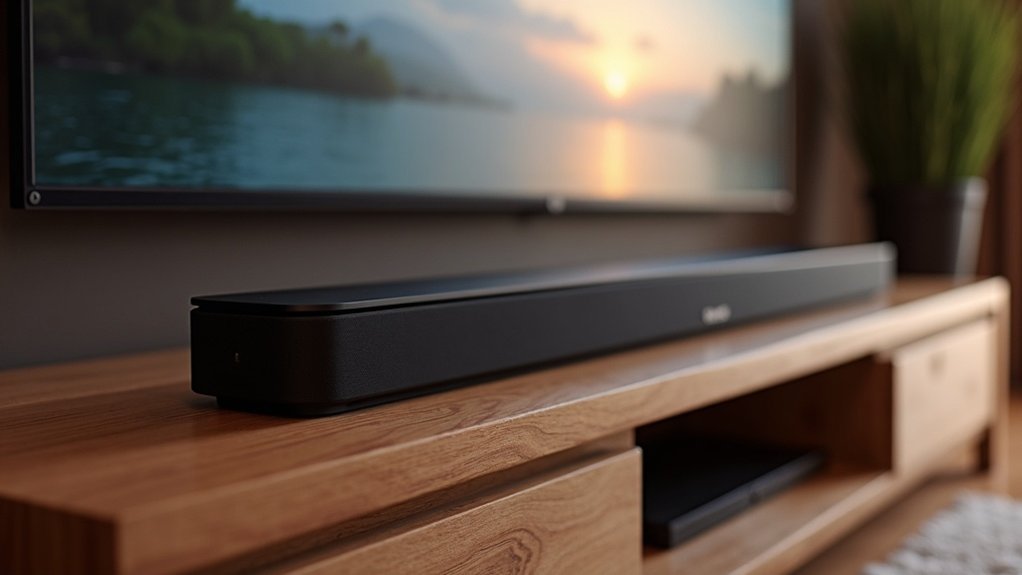
To reduce bass bleed with your soundbar, position it at ear level and 2 to 6 inches from walls to minimize reflections. Regularly utilize room calibration features to fine-tune sound output and employ high-pass filters to cut low frequencies that contribute to bleed. Consider enhancing your space with acoustic treatments, like bass traps in corners, and a decoupling isolation system under the soundbar. These strategies can significantly improve your audio clarity and overall listening experience with your soundbar.
Key Takeaways
- Position the soundbar at ear level and maintain a distance of 2 to 6 inches from walls to minimize bass reflections, enhancing your overall sound experience.
- Utilize room calibration features that many soundbars offer to adjust sound output and effectively counteract unwanted bass resonance in your space.
- Implement wall treatments with sound-absorbing materials around your soundbar setup to reduce low-frequency transmission and improve overall sound clarity.
- Consider integrating a high-pass filter in your audio setup to selectively attenuate low-frequency sounds that may contribute to bass bleed.
- Utilize bass traps in corners of your room and implement decoupling isolation systems to control resonance and minimize unwanted mechanical energy transfer, leading to a cleaner audio performance.
Understanding Bass Bleed
Bass bleed is a common issue that can occur with soundbars when low-frequency sounds transmit into adjacent spaces, causing disturbances.
Low frequencies, around 20 Hz, have long wavelengths that easily travel through walls and floors, making them difficult to contain. The construction materials of your space can influence this problem; wooden floors often amplify bass bleed, while concrete slabs provide more resistance.
This creates a need for effective solutions when using soundbars. By understanding your room’s acoustics and implementing isolation systems or decoupling techniques, you can significantly reduce the mechanical energy transfer, enhancing sound quality and minimizing muddied bass perceptions for a better listening experience with your soundbar.
Positioning Your Soundbar
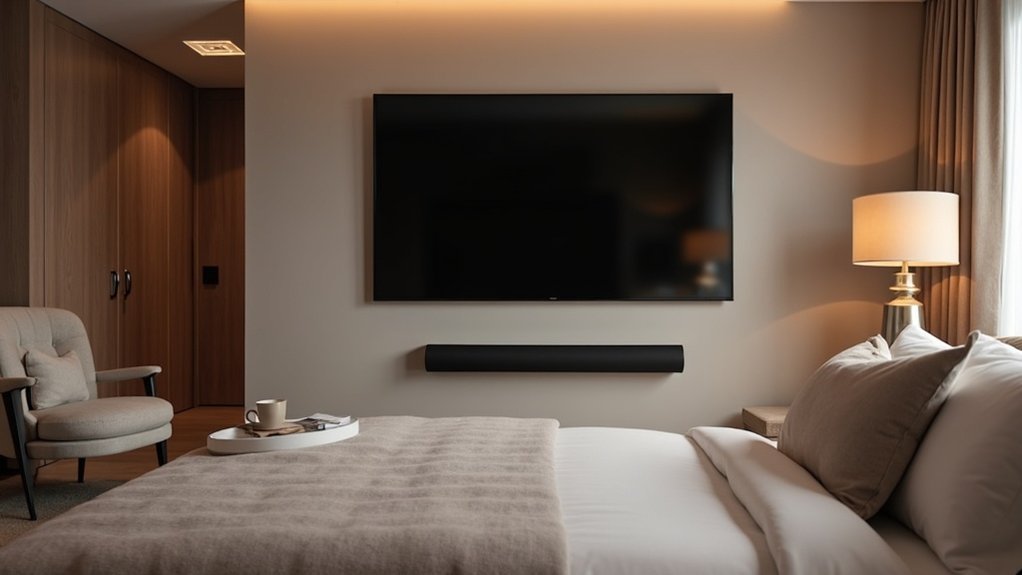
To effectively reduce bass bleed from your soundbar, position it at ear level while seated to ensure optimal sound directionality.
Maintain a sufficient distance from walls and corners, as these surfaces can amplify unwanted bass frequencies.
Optimal Height Placement
Positioning your soundbar at the ideal height is essential for achieving clear audio and minimizing bass bleed. Aim for ear level when seated, typically between 36 to 42 inches high, to ensure optimal sound clarity from your soundbar.
Mounting the soundbar directly below or above your TV aligns audio output with your visual experience, effectively reducing perceived bass interference. Avoid placing your soundbar in enclosed spaces, as this can trap sound waves and worsen bass bleed.
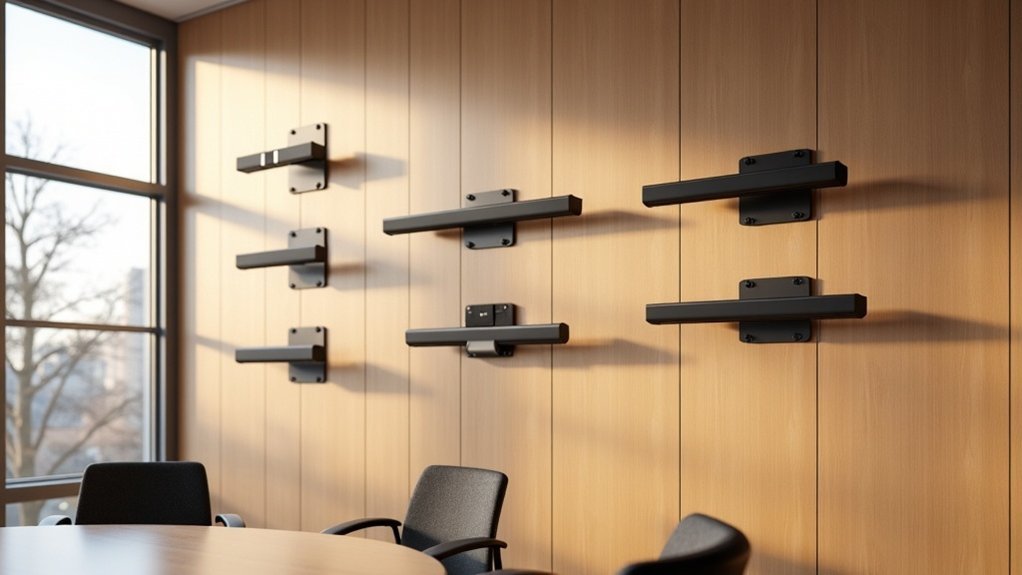
Maintain a distance of 2 to 6 inches from walls and corners to minimize bass reflections. Additionally, consider using adjustable mounts to fine-tune the height and angle of your soundbar for the best sound dispersion and bass control.
Distance From Walls
Maintaining a distance of at least 6 to 12 inches between your soundbar and walls is essential for minimizing bass reflection. This spacing helps prevent sound waves from bouncing back, which can cause bass bleed. Ideally, position your soundbar in free space for maximum sound dispersion. Angle it slightly away from walls to further reduce low-frequency reflections. Avoid corners, as these amplify bass frequencies due to the boundary effect. Experimenting with different placements can help you discover the best position for your room’s acoustic characteristics.
| Distance from Wall | Effect on Bass | Recommended Placement |
|---|---|---|
| 0-6 inches | Increased bleed | Avoid |
| 6-12 inches | Moderate bleed | Ideal |
| 12+ inches | Minimal bleed | Best |
Utilizing Room Calibration Features
Room calibration features in modern soundbars offer an effective solution for minimizing bass bleed. These systems utilize built-in microphones to analyze your room’s acoustics, adjusting the sound output to counteract unwanted bass resonance.
By employing advanced DSP algorithms, soundbars can specifically target low-frequency output, helping to control bass levels effectively. This tailored approach often results in a more balanced sound profile, enhancing clarity and reducing bass bleed into adjacent spaces.
It’s essential to recalibrate your soundbar regularly, especially after any changes in furniture layout or room acoustics, to maintain peak performance and ensure continued reduction of bass interference.
Implementing High-Pass Filters
To effectively manage bass bleed from your soundbar, understanding high-pass filters is essential.
These filters attenuate low-frequency signals, enhancing audio clarity by allowing only frequencies above a designated cutoff to pass through.
Implementing a high-pass filter, typically set around 80 Hz, can greatly improve dialogue intelligibility and overall sound quality, making your soundbar experience more enjoyable.
Understanding High-Pass Filters
High-pass filters play an essential role in optimizing sound quality in soundbars by selectively allowing higher frequencies to pass while attenuating lower ones.
By incorporating a high-pass filter into your soundbar setup, you can effectively reduce bass bleed that resonates through walls and floors. Many soundbars feature built-in low-frequency containment options that act as high-pass filters, simplifying bass management.
You can adjust the cutoff frequency to fit your room’s acoustics, ensuring problematic low frequencies are minimized. This adjustment enhances overall clarity, preventing low-frequency muddiness and noticeably improving the perceived sound quality of your soundbar.
Benefits of Attenuation
While implementing high-pass filters in your soundbar setup may seem like a technical detail, the benefits of attenuation are significant for enhancing your listening experience.
By effectively reducing deep bass frequencies, these filters minimize bass bleed into adjacent spaces, ensuring a cleaner audio experience in your home theater. They prevent excessive mechanical energy transmission, which is essential in shared living environments where sound quality is paramount.
High-pass filters enhance sound quality by reducing room resonance and preventing muddiness, which clarifies dialogue and mid-range frequencies, making your favorite movies and shows more enjoyable.
In wooden floor settings, they’re particularly valuable for curbing bass resonance that can disrupt the audio experience. Adjusting the cutoff frequency allows you to customize sound management, achieving the perfect balance between bass presence and clarity for your soundbar.
Implementation in Soundbars
Effectively implementing high-pass filters in soundbars can significantly enhance audio clarity and minimize bass bleed.
These filters enable frequencies above a specific cutoff point to pass while attenuating lower frequencies that often penetrate walls. Most modern soundbars come with built-in low-frequency containment options, which help manage bass output and reduce interference with other audio components.
However, the effectiveness of high-pass filters can vary based on your acoustic environment, so you may need to adjust settings for optimal performance.
Adjusting Equalizer Settings
To reduce bass bleed effectively, you should start by adjusting the equalizer settings on your soundbar. Lower the frequencies around 60-100 Hz, as these contribute to excessive bass output.
Utilize a high-pass filter to cut off deeper bass sounds, minimizing their transmission. Experiment with various equalizer presets; many soundbars include modes optimized for different environments, helping to alleviate unwanted bass resonance.
Additionally, manually adjust the subwoofer channel’s gain on your soundbar to balance overall sound levels. Regularly test your adjustments across different content types to guarantee a balanced audio experience without excessive bass bleed into surrounding areas.
Choosing the Right Wall Treatments
When selecting the right wall treatments for enhancing your soundbar experience, it’s crucial to consider how they can significantly reduce bass bleed in your space. Effective wall treatments absorb low-frequency sound waves and minimize reflections, leading to a more immersive audio experience.
- Install acoustic panels to absorb low frequencies, which can help clarify the sound output from your soundbar.
- Incorporate bass traps in corners to contain unwanted resonance that can muddy your audio.
- Use heavy curtains or soundproofing materials to dampen sound transmission and improve overall sound fidelity.
- Strategically position treatments opposite your soundbar and in corners for optimal results.
Exploring Additional Accessories
While you may have implemented wall treatments to reduce bass bleed, exploring additional accessories can further enhance your soundbar’s audio performance.
Consider integrating a high-pass filter to effectively attenuate low-frequency sounds that contribute to bass bleed.
Strategically placed acoustic panels can absorb excess bass frequencies, minimizing their transmission through walls and floors.
A decoupling isolation system under your soundbar can reduce mechanical energy transfer, resulting in cleaner sound.
Additionally, utilizing bass traps in corners helps control low-frequency resonance.
Finally, positioning your soundbar away from shared walls minimizes direct energy transfer, further preventing bass from leaking into adjacent spaces.
These enhancements can help you achieve a more immersive sound experience with your soundbar.