To calibrate your soundbar for a small room, start by positioning it directly below your TV at ear level, avoiding enclosed spaces. Utilize automatic calibration features that many soundbars offer to optimize audio settings for your specific environment. Experiment with equalizer settings to enhance clarity, especially for dialogue, ensuring that you get the best sound quality. Position your subwoofer in a corner for improved bass response and consider adjusting its phase settings for a more cohesive sound. Finally, incorporate soft furnishings like rugs and curtains to minimize sound reflections, enhancing your overall audio experience. Stick around for more detailed tips on maximizing the potential of your soundbar.
Key Takeaways
- Position the soundbar at ear level and centered below the TV to ensure optimal sound clarity in small rooms.
- Utilize the soundbar’s automatic calibration feature to fine-tune audio settings based on the unique acoustics of your space.
- Experiment with equalizer settings to adjust frequencies tailored to your content, with a particular focus on enhancing dialogue clarity.
- Place the subwoofer in a corner or against a wall to amplify bass output without overpowering the room’s acoustics.
- Incorporate soft furnishings like rugs and curtains to reduce sound reflections and enhance overall audio quality, making the most of your soundbar experience.
Start With Placement
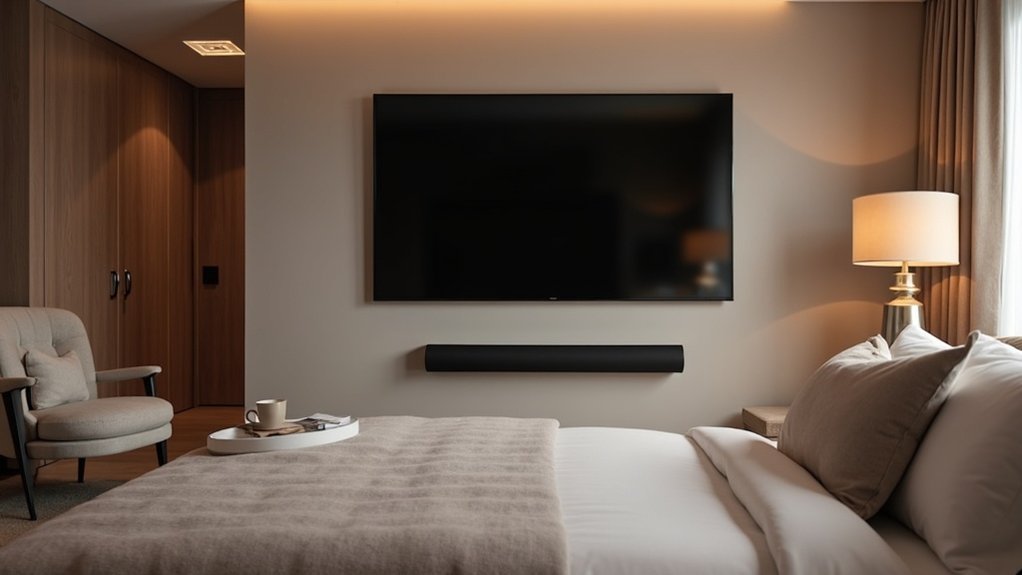
To achieve ideal audio performance in small rooms with your soundbar, start with its placement. Position it directly below the TV, ensuring it’s centered and parallel to the screen. Aim for ear level to enhance sound quality and dialogue clarity.
Avoid enclosing the soundbar in cabinets, as this blocks sound and affects performance. Experiment with different locations, considering the room’s acoustic properties for the best sound dispersion.
If space is tight, wall mounting can improve acoustics, especially with upfiring drivers. Adjust your TV’s settings according to the soundbar’s placement, and remember that proper placement lays the foundation for effective calibration.
Utilize Automatic Calibration Features
While manually adjusting sound settings can enhance your audio experience, leveraging the automatic calibration features in your soundbar often yields superior results.
Many contemporary soundbars are designed to analyze room acoustics and automatically optimize audio settings for the best performance. Ensure your soundbar is correctly positioned and free from obstructions to allow for accurate calibration.
Adhere closely to the manufacturer’s instructions, as a quiet environment is crucial for precise analysis. Some models even provide specific calibration modes tailored for small rooms, improving sound output significantly.
Additionally, don’t forget to regularly check for firmware updates, as these updates can further enhance the effectiveness of your soundbar’s automatic calibration features, ensuring you enjoy the best sound experience possible.
Experiment With Equalizer Settings
Adjusting the equalizer settings on your soundbar can significantly enhance your audio experience, particularly in a small room.
Begin by accessing the built-in equalizer to customize the audio output, focusing on frequency ranges that suit your content, whether it’s movies or gaming.
To improve bass response, consider reducing frequencies around 150Hz to avoid an overwhelming boomy sound. If you find harshness affecting clarity, lower the 10kHz range to enhance dialogue and high-frequency sounds.
Utilize frequency generator apps to test various sound frequencies, helping you identify the optimal EQ settings for your soundbar.
Make subtle adjustments of around 3dB or less for effective calibration, ensuring you maintain sound quality while personalizing your listening experience.
Optimize Subwoofer Location
After fine-tuning your equalizer settings, optimizing the placement of your subwoofer is crucial for achieving a balanced sound experience in your small room.
Follow these steps for ideal placement:
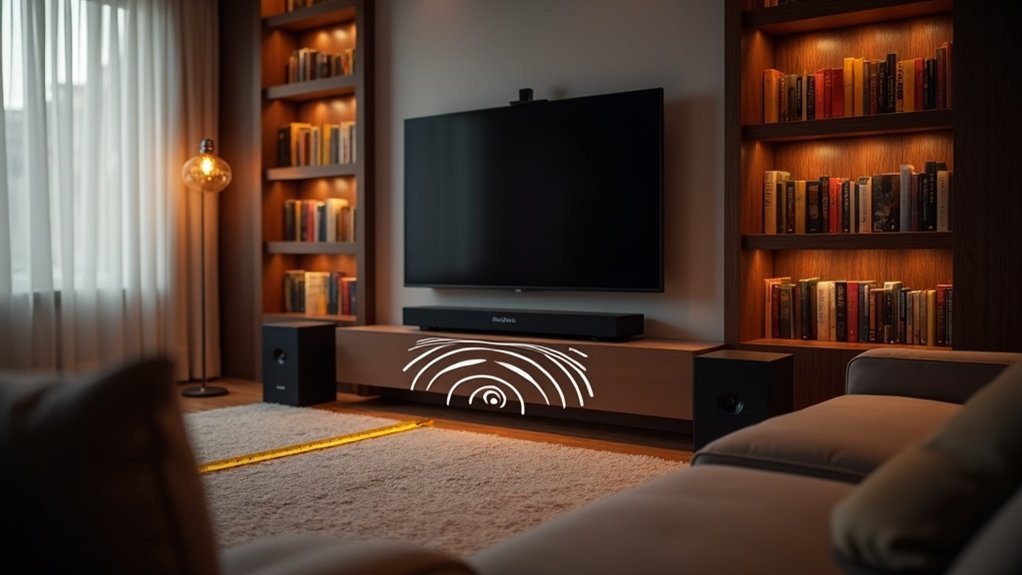
- Position the subwoofer in a corner or against a wall to maximize bass output, enhancing the overall performance of your soundbar.
- Use the “crawling test” to find the best spot by listening from your primary seating area, ensuring the subwoofer complements your soundbar’s output.
- Avoid placing the subwoofer inside cabinets to prevent muffled sound and reduced bass performance, which can detract from the clarity of your soundbar.
- Adjust the phase settings to align with your soundbar for improved low-frequency response and a cohesive sound experience, making your audio more immersive.
Incorporate Soft Furnishings for Better Acoustics
To enhance the acoustics of your small room when using a soundbar, incorporating soft furnishings is essential.
These elements can greatly improve sound quality by reducing reflections and absorbing excess noise. Items like rugs, curtains, and upholstered furniture help mitigate harsh sound waves that bounce off hard surfaces, leading to clearer audio and minimized echo.
Strategically arranging these soft materials can enhance sound dispersion, ensuring that the sound from your soundbar reaches your ears more directly. This setup effectively lowers background noise, allowing for clearer dialogue and a more immersive audio experience.
Don’t hesitate to experiment with the arrangement; finding the ideal layout can notably boost the overall acoustics of your space, maximizing the performance of your soundbar.