To calibrate your soundbar for an optimal movie experience, begin by positioning it directly beneath your TV and ensuring the calibration microphone is at ear level. Take advantage of the soundbar’s automatic calibration features to evaluate room acoustics and effectively adjust speaker distances. Pay special attention to mid-range EQ settings to improve dialogue clarity, and ensure you have the best audio quality by connecting through HDMI ARC. Don’t forget to explore different surround sound modes for a more immersive viewing experience. Additionally, consider subwoofer placement and other enhancements to elevate your overall setup.
Key Takeaways
- Utilize the automatic calibration features of your soundbar by positioning the microphone at ear level for precise adjustments based on your room’s acoustics.
- Ensure your soundbar is placed directly below the TV, centered and parallel, to achieve optimal audio projection.
- Fine-tune the equalizer settings to improve dialogue clarity, emphasizing mid-range frequencies and utilizing any built-in dialogue enhancement modes.
- Connect your soundbar to the TV through HDMI ARC or eARC, and configure the TV’s HDMI output to “Enhanced” for high-resolution audio playback.
- Regularly recalibrate your settings for various movie genres and monitor subwoofer levels to prevent them from overshadowing dialogue.
Importance of Calibration for Movies
When you calibrate your soundbar for movies, you’re not just adjusting settings; you’re greatly enhancing your audio experience. Calibration is vital for achieving ideal sound, balancing levels across all speakers to guarantee dialogue clarity and immersive sound effects.
Proper calibration adjusts the dynamic range, essential for the varying sound levels in films, allowing for a rich viewing experience without disrupting others. Utilizing sound modes like Dialogue Enhancement considerably improves voice intelligibility, ensuring that every line is heard clearly.
Additionally, taking into account room acoustics during calibration helps overcome acoustic challenges, ensuring that you get the best possible sound quality from your soundbar for movie watching. This attention to detail transforms your home into a cinematic experience.
Utilizing Automatic Calibration Features
Many modern soundbars come equipped with advanced calibration tools designed to optimize audio settings according to your room’s acoustics.
To achieve the best results, position the calibration microphone at ear level in your primary listening spot before initiating the calibration process.
This ensures that the soundbar accurately adjusts levels, equalization, and delay settings, significantly enhancing your movie-watching experience.
Built-in Calibration Tools
To achieve the best sound quality from your soundbar, utilizing its built-in automatic calibration tools is essential.
These tools assess room acoustics, adjusting audio settings for optimal sound performance. The calibration process involves placing the microphone at ear level in your primary listening position and following on-screen prompts.
Key benefits include:
- Adjustments for equalization and speaker distances
- Advanced room correction technology for sound absorption
- Regular updates to maintain an immersive audio experience
Speaker Positioning Considerations
Utilizing built-in calibration tools can greatly enhance your soundbar’s performance, but speaker positioning also plays an essential role in achieving the best audio experience.
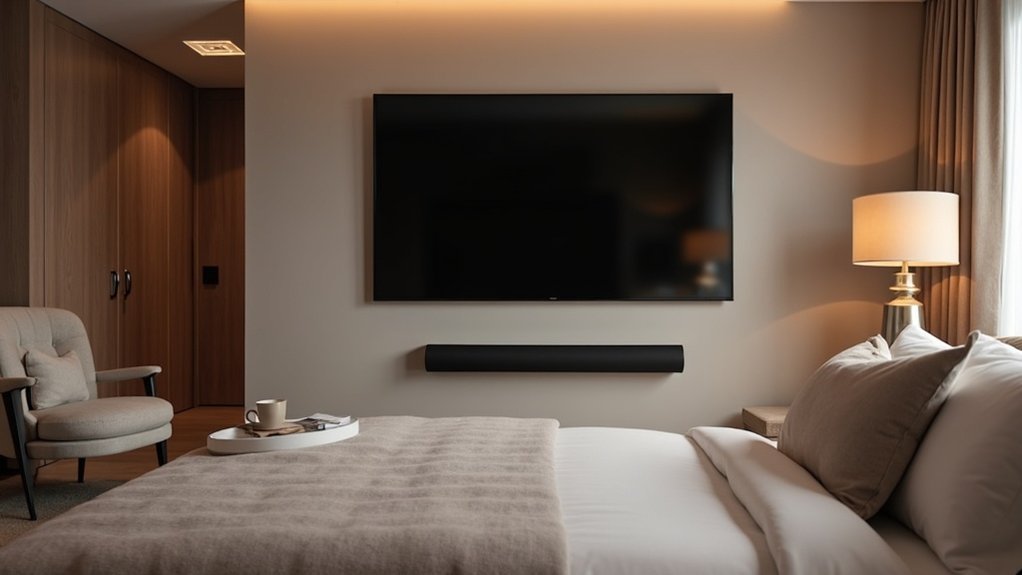
Position your soundbar directly below the TV, ensuring it’s centered and parallel to the screen for optimal audio clarity.
Take advantage of the calibration feature by placing the microphone at ear level within your primary listening area. This allows for accurate adjustments based on room acoustics.
Ensure that the soundbar’s drivers are unobstructed, avoiding any furniture or decor that might interfere with sound projection.
Following the manufacturer’s instructions during calibration will guarantee precise audio settings, enhancing your surround sound experience and overall audio clarity.
Adjusting Equalizer Settings for Dialogue Clarity
How can you ensure dialogue remains clear and distinct while enjoying movies on your soundbar? Start by utilizing the built-in dialogue enhancement modes to boost human voice frequencies for maximum clarity.
Ensure clear dialogue on your soundbar by using built-in enhancement modes to amplify human voice frequencies for better clarity.
Adjust your equalizer settings by focusing on mid-range frequencies between 1 kHz and 4 kHz while keeping bass and treble well-balanced.
- Test audio presets specifically designed for movie content.
- Regularly calibrate your EQ settings to suit different genres.
- Adjust the subwoofer level to prevent low frequencies from overpowering dialogue.
Experimenting With Surround Sound Modes
Building on the clarity of dialogue achieved through equalizer adjustments, experimenting with the various surround sound modes available on your soundbar can significantly enhance your home theater experience.
Engage different surround sound modes to create immersive audio tailored to specific movie genres. For instance, action films may benefit from modes that emphasize sound effects, while dialogue enhancement modes can boost clarity for dramas.
Fine-tune your audio output by adjusting equalizer settings alongside these modes, ensuring a balanced listening experience.
Don’t hesitate to switch modes throughout your movie marathon to discover which configurations best elevate your enjoyment of each film on your soundbar.
Subwoofer Placement and Configuration
Proper subwoofer placement and configuration can significantly enhance your soundbar’s performance, particularly in delivering rich, impactful bass.
To create an immersive audio experience with your soundbar, consider the following tips:
- Position the subwoofer on the floor, preferably in a corner or against a wall to amplify bass output.
- Utilize the “crawling test” to determine the optimal location by moving the subwoofer while playing bass-heavy content.
- Adjust the phase setting to ensure synchronization with your soundbar, minimizing sound lag and improving TV synchronization.
Ensuring Optimal Connections for Sound Quality
To achieve the best sound quality from your soundbar, it’s essential to ensure the right connections are established.
Connect your soundbar to the TV using HDMI ARC or eARC ports to support advanced surround formats such as Dolby Atmos and Dolby TrueHD.
Connect your soundbar via HDMI ARC or eARC for superior surround sound capabilities like Dolby Atmos and Dolby TrueHD.
Be sure to set your TV’s HDMI output to “Enhanced” mode to enable high-resolution audio formats.
Utilizing a bitstream setting on your TV or streaming device will allow your soundbar to effectively decode surround formats.
For optimal audio performance, consider a direct connection from your soundbar to the streaming device.
Additionally, using high-quality cables will help prevent audio lag and ensure a seamless audio experience.