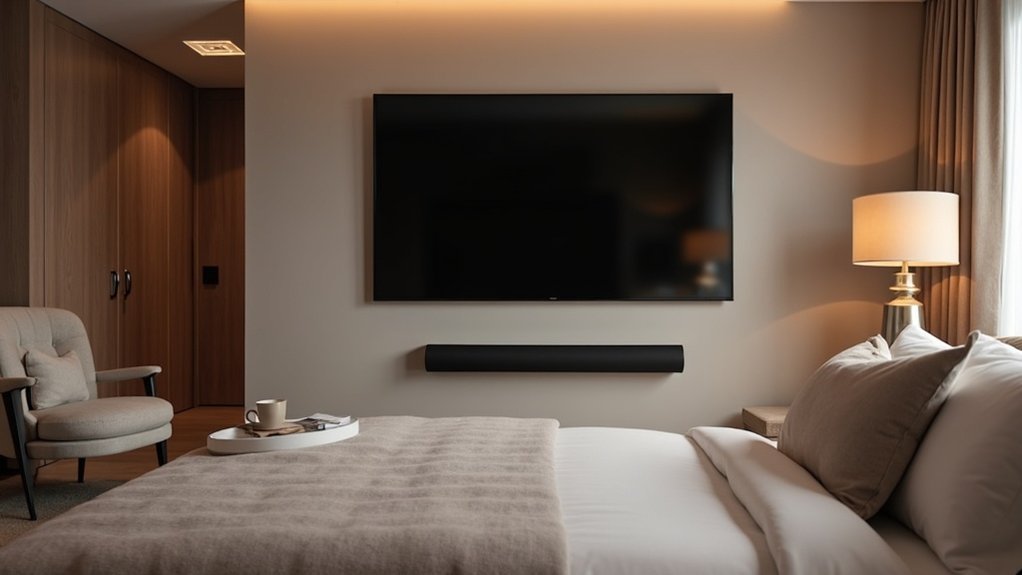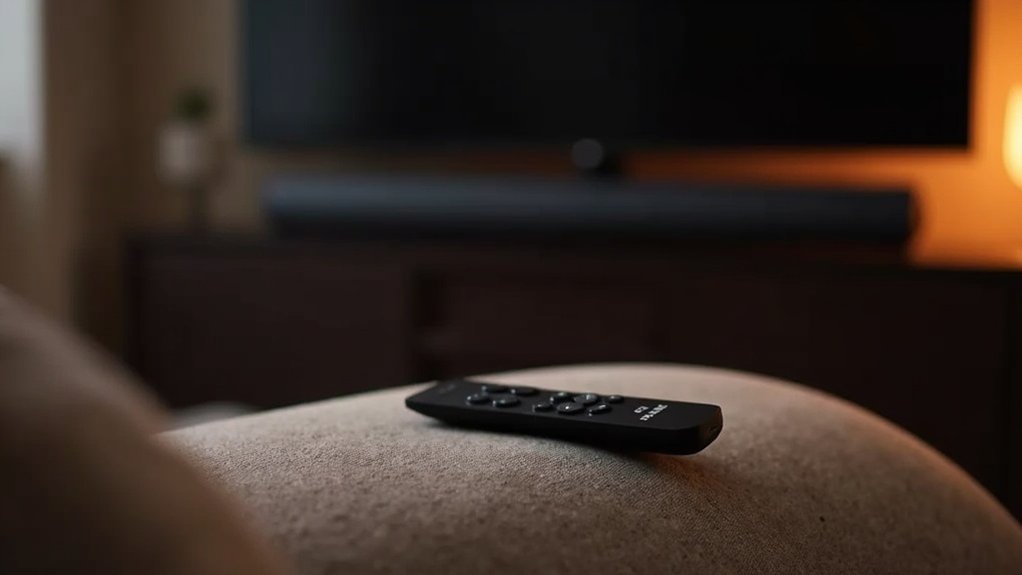
Yes, you can control your soundbar with the Fire TV remote if both devices support HDMI-CEC and are properly connected. Simply link them using an HDMI cable that supports CEC to enable integrated controls for volume and power. If your soundbar and TV aren’t compatible, there are alternatives, like programming infrared settings or using universal remotes. For a seamless sound experience, ensure your soundbar is set up correctly and explore additional features that could enhance your audio setup.
Key Takeaways
- Yes, a soundbar can be controlled with the Fire TV remote if both devices support HDMI-CEC.
- Connect the soundbar to the TV using an HDMI cable that supports CEC for seamless control.
- Access Firestick Settings to add the soundbar under Equipment Control for remote management.
- For optical connections, manual programming of the Fire TV remote may be necessary to control the soundbar.
- If HDMI-CEC is unavailable, consider using universal remotes or the Fire TV app for soundbar control.
Understanding HDMI-ARC and CEC Features
When you’re setting up your soundbar with your TV, understanding HDMI-ARC and CEC features is essential for a seamless audio experience.
HDMI-ARC (Audio Return Channel) allows audio to flow from your TV back to the soundbar using a single HDMI cable, simplifying your audio connections.
CEC (Consumer Electronics Control) enables your devices to communicate, allowing you to control the soundbar’s volume and power using your TV remote.
For CEC to work effectively, both your TV and soundbar must support it and have the necessary settings enabled.
This combination minimizes remote clutter and enhances your overall soundbar setup, making everything easier to manage.
Setting up Your Soundbar With Fire TV
To set up your soundbar with a Fire TV, begin by connecting the soundbar using an HDMI cable that supports CEC.
This feature enables your Fire TV remote to effortlessly control both the volume and power of the soundbar.
With CEC functionality, your Fire TV remote can easily manage your soundbar’s volume and power.
If you choose to use an optical connection instead, you’ll need to program the Fire TV remote to send infrared signals, as optical connections don’t support CEC functionality.
To add your soundbar for remote control, navigate to the Firestick Home, select Settings, and then go to Equipment Control.
Additionally, be sure to check for the latest Fire TV software updates to improve compatibility and functionality with your soundbar.
Compatibility With Different Soundbar Models
When it comes to using your Fire TV remote with a soundbar, compatibility largely depends on the brand and connection type.
Many popular soundbars, like Sonos and Yamaha, are compatible through HDMI using CEC, ensuring seamless integration.
However, those connected via optical cables often require manual setup.
It’s essential to check if your specific soundbar supports HDMI-CEC for the best experience, as some models may also feature IR learning modes for added flexibility.
Always refer to your soundbar’s specifications for detailed compatibility information.
Supported Soundbar Brands
The compatibility of soundbars with the Fire TV remote enhances your home entertainment experience by streamlining control over audio settings. Supported soundbar brands like Sonos, Bose, and Yamaha allow you to manage volume and playback seamlessly.
If your soundbar supports CEC functionality and is connected via HDMI ARC, you can enjoy effortless control without the need for extra remotes. However, if you choose to connect via optical or auxiliary, you may need to program the Fire TV remote’s infrared codes.
Configuring your Fire TV settings through the Equipment Control menu ensures your specific soundbar model is recognized for optimal performance.
Connection Type Impact
Understanding how connection types impact compatibility with various soundbar models is crucial for optimizing your Fire TV remote’s performance. Soundbars connected via HDMI using CEC enable you to control volume and power directly from your remote. In contrast, optical connections do not support CEC, necessitating manual programming of infrared remotes for functionality. However, some modern soundbars, such as those from Sonos, can learn infrared codes, allowing for basic control even when using optical connections. Always consult your soundbar’s specifications to ensure you achieve the best remote control experience.
| Connection Type | CEC Support | Remote Control Capability |
|---|---|---|
| HDMI | Yes | Direct |
| Optical | No | Manual setup required |
| Sonos (Optical) | No | Limited functionality, learns codes |
| Bluetooth | Yes | Direct |
Troubleshooting Common Connection Issues
If you’re having trouble controlling your soundbar with the Fire TV remote, it could be related to connection issues.
Ensure you’re using the appropriate HDMI ARC or optical setup, as these configurations can significantly influence performance.
Additionally, review your remote’s programming and the soundbar’s settings to effectively troubleshoot any problems you may encounter.
HDMI Connection Issues
Connecting your soundbar to your TV via HDMI can greatly enhance your audio experience and simplify control with your Fire TV remote. However, several issues may arise that could hinder this seamless setup.
First, ensure that HDMI-CEC is enabled on both your soundbar and TV for optimal functionality. If your soundbar isn’t responding, double-check that the HDMI cable is securely connected to the correct HDMI ARC port on both devices.
Additionally, verify your Fire TV settings by navigating to Settings > Equipment Control to select your soundbar model. If you continue to experience issues, try power-cycling all devices to refresh the HDMI connections.
As a fallback option, consider using an optical cable as an alternative audio solution to maintain high-quality sound.
Optical Connection Challenges
Connecting your soundbar to a Fire TV via optical cable can enhance your audio experience, but it often comes with specific challenges.
A primary concern is that the optical connection doesn’t support HDMI-CEC functionality, which means your Fire TV remote won’t be able to directly control the volume of your soundbar. To address this, you may need to manually program your soundbar to respond to the infrared signals from the Fire TV remote.
If you experience any issues with volume control, ensure that the optical cable is firmly connected and that your soundbar is set to the proper input. Additionally, check the settings on your soundbar to confirm it’s configured to accept commands from the Fire TV remote.
Remote Programming Solutions
When you’re experiencing difficulties controlling your soundbar with the Fire TV remote, troubleshooting the remote programming can often lead to a solution. Ensure your soundbar is connected via HDMI with CEC enabled for seamless volume control. If you’re using an optical connection, you’ll need to manually program the Fire TV remote to emit infrared signals. Below is a table summarizing key troubleshooting steps specifically for soundbars:
| Issue | Solution | Connection Type |
|---|---|---|
| No sound from soundbar | Check CEC settings | HDMI |
| Remote not responding | Reprogram or reset soundbar | Optical |
| Incorrect input selected | Verify input settings | Both |
User Experiences and Feedback
How do users feel about controlling their soundbars with the Fire TV remote? Many appreciate the seamless integration when their soundbars connect via HDMI with CEC enabled, allowing for direct volume control.
However, feedback reveals challenges for those using optical cables, as these connections typically don’t support CEC functionality. Users often express confusion over setup requirements between HDMI and optical connections.
For instance, when setting up a Sonos soundbar, proper programming of the soundbar to recognize the remote’s infrared codes is essential.
Alternatives for Controlling Your Soundbar
What options do you have for controlling your soundbar if HDMI-CEC isn’t an option? Here are several alternatives to consider:
- Program your Fire TV remote to send infrared signals to your soundbar for direct control.
- Opt for soundbars that can learn infrared codes from your Fire TV remote, ensuring seamless operation without extra remotes.
- Look into universal remotes designed to manage both soundbars and Fire TV, helping to simplify your remote collection.
Additionally, you can utilize app-based control through the Fire TV app, allowing you to adjust volume and settings directly from your mobile device.
These alternatives ensure you maintain control over your soundbar, even without direct HDMI connectivity.