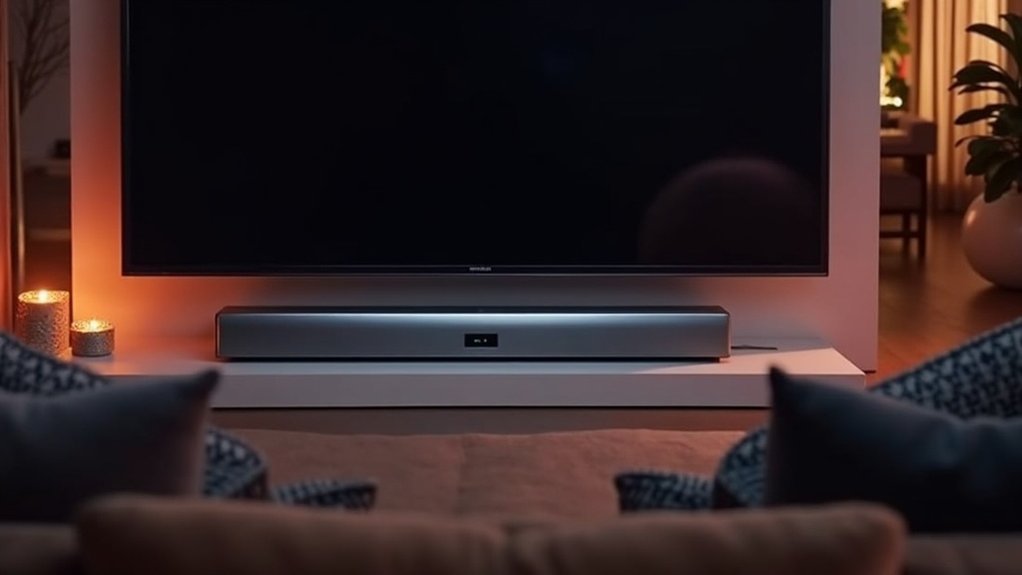
To use a soundbar as a center channel, first position it at ear level between your front left and right speakers. Ensure you select the appropriate wiring configuration, particularly if you’re utilizing a passive soundbar that requires speaker wires. Adjust your audio settings on your AV receiver to improve dialogue clarity, and keep an eye out for any audio synchronization issues. While you may encounter some common challenges, there are also effective alternatives worth exploring to enhance your soundbar experience.
Key Takeaways
- Position the soundbar at ear level and center it between the left and right speakers for optimal dialogue clarity.
- Choose the appropriate wiring configuration: passive soundbars use standard speaker wire, while active soundbars may require verification of center channel pre-outs.
- Pay attention to impedance to ensure balanced sound output and prevent sound localization issues.
- Be aware of potential audio synchronization challenges between the soundbar and other speakers, adjusting settings if necessary to achieve the best performance.
- If sound quality is compromised with the soundbar setup, consider exploring advanced soundbar models designed for enhanced dialogue clarity.
Understanding Soundbars and Their Functionality
Soundbars serve as a compact solution for enhancing your audio experience, utilizing multiple internal speakers and advanced processing to simulate surround sound.
While they aren’t specifically designed as dedicated center channel speakers, they can still be integrated into a home theater setup.
Active soundbars come with built-in amplification, which can complicate their use as center channels, while passive soundbars offer easier wiring options.
However, using a soundbar in this capacity may lead to phase cancellation issues, potentially degrading sound quality and affecting audio positioning.
To optimize performance, it’s important to consider your room’s acoustic properties when integrating a soundbar into your home theater system.
Types of Soundbars: Passive vs. Active
When deciding between passive and active soundbars, understanding their distinct features is essential for achieving the best audio performance in your home theater.
A passive soundbar requires an AV receiver for power and can easily be integrated as a center channel, making it ideal for surround sound setups.
In contrast, an active soundbar comes with built-in amplification but can complicate center channel integration due to its dependency on surround or stereo signals.
While passive soundbars typically combine left, center, and right speakers for straightforward wiring, active soundbars may require additional adapters for compatibility, which can affect their flexibility in traditional audio configurations.
Setting Up Your Soundbar as a Center Channel
To set up your soundbar as a center channel, start by selecting the appropriate wiring configuration. This could involve using a passive model connected via speaker wires or an active soundbar with a center channel input.
Placement is crucial; ensure that the soundbar is positioned at ear level and centered between your front left and right speakers to achieve optimal audio clarity.
Proper setup and positioning will significantly enhance dialogue clarity and provide a seamless sound experience.
Wiring Configuration Options
While setting up a soundbar as a center channel, it’s vital to take into account the wiring configuration to guarantee ideal audio performance.
For passive soundbars, connect them to your AV receiver using standard speaker wire, confirming proper impedance, typically aiming for 6-8 ohms. You may wire them in series or parallel with other speakers to achieve the correct load.
If you’re using an active soundbar, verify your AV receiver has a center channel pre-out and consider using digital or analog adapters for compatibility.
Proper wiring is important to avoid sound localization issues and protect your audio equipment.
Optimal Placement Considerations
Positioning your soundbar effectively is essential for maximizing audio performance as a center channel. Here are some ideal placement considerations to enhance your center channel signal:
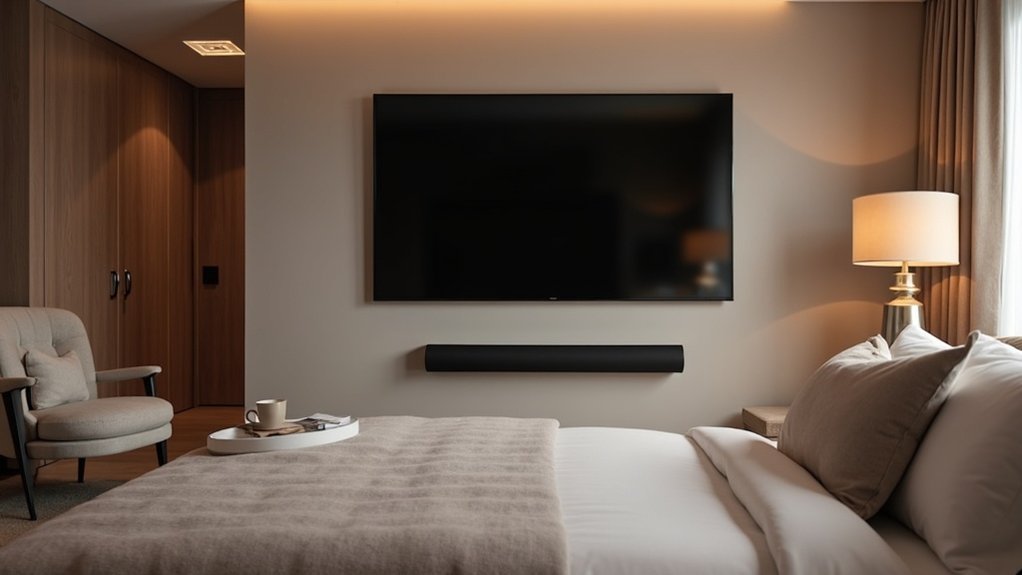
- Place the soundbar directly below or above the TV screen for better audio localization with on-screen action.
- Position it at ear level when seated to improve clarity and reduce sound muddiness from reflections.
- Angle the soundbar slightly towards the listening area to enhance direct sound delivery.
Wiring Configurations for Soundbars
When wiring your soundbar as a center channel, it’s essential to consider both passive and active configurations.
Passive soundbars can be connected using standard speaker wire, while active soundbars may require adapters for proper integration with your AV receiver.
It’s crucial to pay attention to impedance to ensure balanced sound output across your audio setup.
Passive Soundbar Wiring Options
Passive soundbars provide a range of wiring options that can significantly enhance your home audio experience. To configure your passive soundbar as a center channel, consider the following methods:
- Connect the passive soundbar directly to your AV receiver using standard speaker wire for straightforward setup.
- Adhere to proper impedance guidelines by wiring the left and right channels either in series or parallel, ensuring you achieve the appropriate loads (4, 6, or 8 ohms) for optimal performance.
- Implement a phantom center channel setup to share the center audio signal between your front left and right speakers, which helps maintain clarity in sound reproduction.
Correct wiring and configuration are crucial to prevent sound localization issues and to achieve a cohesive and immersive audio experience.
Active Soundbar Connection Methods
Active soundbars typically require specific wiring configurations to integrate seamlessly into your home theater system. A center channel pre-out from your AV receiver is often needed for optimal audio routing. For analog connections, a 3.5mm Aux port may be necessary. Digital connections might require a mono-to-stereo adapter to maintain audio quality. It’s important to select the correct input on your soundbar and disable any DSP features for direct sound output. Proper wiring is essential to prevent over-amplification and achieve the best listening experience.
| Connection Type | Required Cables | Audio Quality |
|---|---|---|
| Analog | 3.5mm Aux | Moderate |
| Digital | Mono-to-stereo adapter | High |
| HDMI | HDMI cable | Best |
Impedance Considerations and Tips
To ensure optimal performance when wiring a soundbar as a center channel, it’s crucial to match the impedance between the soundbar and your amplifier. Here are some valuable tips:
- Aim for a total load of 6-8 ohms to prevent overloading your receiver.
- Connect left and right speakers in series for a 16-ohm load, while wiring the center soundbar in parallel.
- Avoid directly connecting the soundbar between left and right amplifier outputs to prevent sound localization issues.
Always refer to your soundbar’s specifications for impedance ratings and make sure your receiver’s settings align with your wiring configuration.
Audio Settings for Optimal Performance
When setting up your soundbar as a center channel, adjusting the audio settings on your AV receiver is crucial for optimal performance.
Start by disabling the center channel output to prevent any overlap, allowing the soundbar to handle all center audio responsibilities effectively. Set the soundbar to “Direct” or “Bypass” mode to ensure the center channel signal remains unaltered.
If you’re using an active soundbar, connect a mono to stereo adapter to ensure proper signal distribution.
Regularly check the speaker levels in your AV receiver’s setup menu to balance the soundbar with other speakers, ensuring clear dialogue and cohesive audio throughout your sound system.
Common Challenges and Limitations
While utilizing a soundbar as a center channel might appear to be a practical option, it presents several challenges and limitations that can significantly affect your audio experience.
Here are some important factors to consider:
- Sound Quality: Soundbars aren’t specifically designed for dedicated center channel use, which can lead to compromised dialogue clarity and overall sound performance.
- Audio Synchronization: When integrating a soundbar with existing left and right speakers, there may be issues with audio synchronization, resulting in an unbalanced listening experience.
- Integration Challenges: Many televisions don’t support simultaneous audio outputs, making it difficult to integrate soundbars with traditional center speakers.
This can lead to improper wiring that risks damaging your equipment.
Alternatives to Soundbars for Center Channel Use
If you’re exploring alternatives to using a soundbar for center channel audio, dedicated center channel speakers are an excellent option for enhancing dialogue clarity in home theater setups.
For those who prefer a more compact solution, on-wall speakers like the Polk Audio VM20 and VM10 can deliver impressive audio performance while saving space.
While passive soundbars can be connected to an AV receiver, they often don’t match the fidelity of specialized center speakers.
Additionally, compact options such as the Polk Audio TL Blackstone series are designed to ensure excellent dialogue reproduction.
If you’re seeking a more innovative approach, you can also create a phantom center channel by strategically positioning your left and right speakers, allowing for clear dialogue without needing a physical center speaker.
User Experiences and Recommendations
While many users have found success using passive soundbars as center channels, experiences can vary considerably.
Here are some recommendations based on user feedback:
- Placement: Ensure your soundbar is positioned at ear level to achieve optimal sound quality.
- Audio Settings: Adjust the receiver’s settings to enhance dialogue clarity, particularly if you notice uneven sound distribution.
- Room Acoustics: Take into account your room’s acoustics, as they significantly influence the soundbar’s performance in this capacity.
Ultimately, while some users appreciate the sound quality of passive soundbars, others find it lacking compared to dedicated center speakers.
Therefore, personal preferences play a crucial role in your choice.