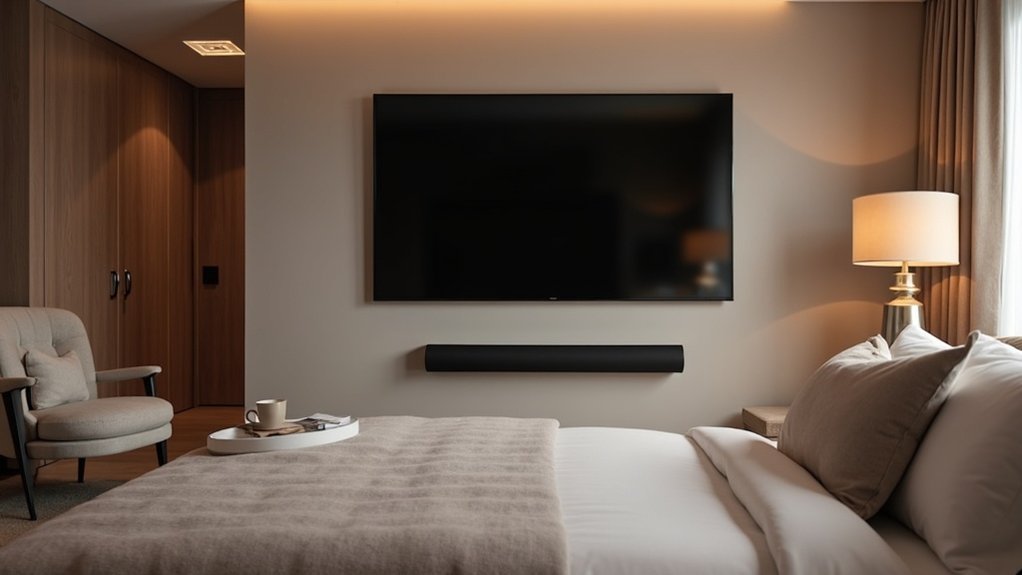
To fix your soundbar’s ARC not working, first, ensure that both the TV and soundbar are connected to the correct ARC or eARC ports. Check the audio settings on your TV to confirm that HDMI ARC is selected as the output and set the digital audio output to PCM for compatibility. Power cycle your devices by unplugging them for five minutes, then reconnect them securely. If you continue to experience issues, inspect your HDMI cables for any damage and adjust the settings as needed. You may find additional troubleshooting steps and tips below.
Key Takeaways
- Ensure both the soundbar and TV are connected to HDMI ARC or eARC labeled ports for optimal sound performance.
- Check and adjust the TV audio settings to select HDMI ARC as the output source for the soundbar.
- Power cycle both the soundbar and TV by unplugging them for five minutes to reset any temporary glitches.
- Use a high-speed HDMI cable and inspect it for any visible damage that could disrupt the audio connection.
- Enable HDMI CEC on the TV to enhance communication between the soundbar and TV, ensuring seamless operation.
Understanding HDMI ARC Functionality
As you delve into the world of soundbars, it’s essential to understand the functionality of HDMI ARC (Audio Return Channel). This feature significantly simplifies audio connections between your soundbar and TV.
With HDMI ARC, the audio output from your TV can be transmitted through a single HDMI cable, which helps reduce clutter in your entertainment setup. It supports high-quality audio formats, such as Dolby Atmos, which can greatly enhance your listening experience.
HDMI ARC simplifies your setup by transmitting TV audio through a single cable, supporting high-quality formats like Dolby Atmos for an enhanced experience.
Additionally, HDMI ARC facilitates two-way communication via HDMI CEC, allowing you to control power and automatically switch inputs with ease.
To maximize the benefits of your soundbar with HDMI ARC, ensure that both your soundbar and TV are equipped with ARC-compatible ports, often labeled as “ARC” or “eARC,” to ensure optimal performance and compatibility.
Common HDMI ARC Issues
You might encounter several common HDMI ARC issues that can disrupt your audio experience with your soundbar.
First, check your cable connections, as loose or damaged HDMI cables can lead to audio dropouts.
Next, ensure that your soundbar and TV are compatible and that your audio settings are correctly configured for optimal performance.
Cable Connection Problems
One common issue that can cause your soundbar to malfunction via HDMI ARC involves cable connections. Make sure the HDMI cable is securely connected to the HDMI ARC port on both the TV and soundbar. Use high-speed HDMI cables designed for ARC functionality to avoid compatibility problems. Check the labeling on the HDMI ports, as not all support ARC. Inspect the HDMI cable for any damage, as a faulty cable can disrupt audio. If issues persist, try unplugging the HDMI cables, power cycling both devices, and then reconnecting.
| Action | Description |
|---|---|
| Check Connections | Ensure cables are securely connected |
| Use High-Speed Cables | Choose cables specifically designed for ARC |
| Verify Ports | Confirm that the HDMI ARC port is correctly labeled |
| Inspect for Damage | Look for any wear or faults in the HDMI cable |
Device Compatibility Issues
Even after confirming proper cable connections, sound issues with your soundbar can persist due to device compatibility problems.
First, ensure that both your TV and soundbar are HDMI ARC-compatible; if either isn’t, audio transmission will fail. Make sure you’re using the ARC-labeled ports, as not all HDMI ports support this functionality.
Incompatibility might also arise from third-party devices or adapters that lack full HDMI ARC or eARC support. Additionally, outdated firmware can disrupt communication, so keep both your soundbar and TV updated.
Finally, check your audio format settings; if the soundbar can’t decode the selected format, it may result in no sound output despite correct connections.
Audio Settings Adjustments
To ensure optimal audio performance between your soundbar and TV using HDMI ARC, adjusting the audio settings is crucial.
Start by confirming that HDMI ARC is enabled on both your soundbar and TV. Then, set your TV’s audio output to “Auto” or “PCM,” as certain surround sound formats may lead to complications.
It’s also important to check the CEC settings in your TV menu, as activating this feature is essential for HDMI ARC functionality.
Make sure your soundbar is connected to the appropriate HDMI ARC port, since not all ports support ARC.
Lastly, after making these adjustments, restart both your TV and soundbar to ensure the settings take effect properly.
Troubleshooting Steps for Soundbar ARC
When your soundbar’s ARC functionality isn’t working properly, there are several troubleshooting steps you can take to resolve the issue effectively.
First, ensure that both your TV and soundbar are connected to HDMI ports labeled as ARC or eARC, as not all HDMI ports support this feature.
Next, check the audio settings on your TV to confirm that HDMI ARC is selected as the output option, and adjust the digital audio output to PCM.
Additionally, enable CEC Control on your TV to facilitate seamless communication between devices.
Finally, inspect your HDMI connection for any damage, and if issues persist, consider testing with a different high-speed HDMI cable.
Following these steps can significantly enhance your soundbar’s performance.
Power Cycling Your Devices
Power cycling your soundbar can be an effective way to resolve issues with its ARC functionality. To do this, turn off both the TV and the soundbar, unplug them, and wait for about five minutes. This process helps reset any temporary glitches in the HDMI ARC connection. Make sure the HDMI ARC cable is securely connected to the appropriate ports before reconnecting. Regular power cycling can refresh internal memory and enhance audio output reliability.
| Step | Action |
|---|---|
| 1. Turn Off Devices | Power off TV and soundbar |
| 2. Unplug | Disconnect from power sources |
| 3. Wait | Leave for 5 minutes |
| 4. Reconnect | Plug in and power on again |
Adjusting TV Audio Settings
To ensure your JBL Soundbar operates smoothly, begin by designating it as the primary audio output device within your TV’s settings menu.
After that, fine-tune the digital sound settings by alternating between options such as Auto or Pass Through, and set the output to PCM for optimal compatibility.
Additionally, enable the HDMI CEC feature, as it’s crucial for seamless interaction between your TV and soundbar.
Select Audio Output Device
Adjusting your TV’s audio settings is crucial for ensuring that your JBL Soundbar is recognized as the primary audio output device.
Start by navigating to the main settings menu and finding the audio settings section. Here, select your soundbar as the preferred output device.
To optimize compatibility, set the ‘Digital Sound Out’ option to ‘Auto’ or ‘Pass Through.’ If you encounter any issues, switching the audio output format to ‘PCM’ can help troubleshoot by reverting to stereo.
Additionally, it’s important to regularly check for firmware updates, as these updates can improve HDMI audio compatibility between your TV and soundbar, enhancing your overall sound experience.
Adjust Digital Sound Settings
While ensuring ideal audio performance, adjusting the digital sound settings on your TV is essential for proper communication with your JBL Soundbar.
Start by accessing your TV’s main settings menu and selecting the soundbar as the default audio output device. Next, adjust the ‘Digital Sound Out’ settings; toggle between options like Auto or Pass Through, and set the output to PCM for compatibility with your soundbar.
After making these changes, restart your TV to apply them effectively, ensuring the soundbar receives the correct signal via HDMI ARC.
Regularly check for firmware updates for your soundbar to maintain compatibility with various audio formats and the Audio Return Channel.
Enable HDMI CEC Feature
Enabling the HDMI CEC feature is essential for ensuring seamless communication between your TV and JBL Soundbar, as it allows devices connected via HDMI to control each other effectively.
To enable HDMI CEC, access your TV’s main settings menu and navigate to the CEC settings—these may be labeled Anynet+ for Samsung or Bravia Sync for Sony. Activate this feature and restart your TV to ensure the changes take effect.
Next, configure your TV’s audio output settings to use HDMI ARC, selecting the soundbar as the output device for optimal audio performance. If issues persist, adjust the digital audio output to “Auto” or “PCM” for improved compatibility with your soundbar.
Ensuring Proper Cable Connections
Proper cable connections are essential for ensuring your soundbar functions correctly with your TV.
First, confirm that the HDMI cable is plugged into the HDMI ARC (Audio Return Channel) port on both the TV and the soundbar, as not all HDMI ports support this feature.
Next, inspect the HDMI cable for any damage or wear, since a faulty cable can disrupt audio transmission, which is critical for an optimal soundbar experience.
Verify that the cable is securely connected at both ends to avoid loose connections that could hinder sound quality.
If you’re using an HDMI switch or receiver, ensure that it supports ARC and that you’re utilizing the correct ARC-enabled port to achieve peak performance from your soundbar.
When to Seek Professional Help
After confirming that all cable connections for your soundbar are secure and functional, you may still encounter issues that indicate it’s time to consider professional help.
If you’ve exhausted troubleshooting steps—such as checking HDMI ARC connections, updating firmware, or adjusting soundbar settings—without success, a hardware malfunction could be the culprit.
Complex setups involving multiple devices can also complicate resolutions for your soundbar. If you find yourself dealing with intricate audio formats or configurations that seem overwhelming, enlisting professional assistance can provide tailored solutions.
Additionally, if customer support for your soundbar is unresponsive, seeking a qualified technician or audio specialist can enhance your sound experience and effectively resolve persistent connectivity issues.