To adjust your soundbar’s volume limiter, access the settings menu via the remote. Look for the “Volume Limiter” option in the audio section. Use the arrow keys to set the limit according to your preference, typically around 70-80% to minimize distortion. Test the audio at different volumes to ensure clarity without distortion. Regular firmware updates and environmental adjustments can enhance your soundbar’s performance. You’ll find more detailed tips and troubleshooting methods to optimize your sound experience throughout this site.
Key Takeaways
- Access the soundbar settings by pressing the “Menu” or “Settings” button on the remote control.
- Navigate to the “Volume Limiter” option in the audio section using the arrow keys.
- Adjust the volume limiter level based on your personal preferences, and test the sound to check for any distortion.
- Save the new settings before exiting the menu to ensure the changes are applied effectively.
- Regularly monitor and update the firmware of your soundbar for optimal sound performance and adjustments.
Understanding Soundbar Volume Limiters
When using a soundbar, understanding the volume limiter is essential for optimizing your audio experience.
The volume limiter feature restricts the maximum output of the soundbar, preventing distortion and protecting the speakers during loud playback.
The volume limiter feature safeguards your soundbar’s speakers by capping maximum output, ensuring clear audio without distortion.
It’s important to note that many soundbars allow you to adjust these settings through the device menu or the remote control, providing flexibility based on your listening preferences.
This feature also helps maintain consistent audio levels in environments with fluctuating sound dynamics, enhancing your overall enjoyment.
For detailed instructions on accessing and modifying the volume limiter settings, consult your soundbar’s user manual.
Accessing the Soundbar Settings Menu
To access the Soundbar settings menu, begin by identifying the “Menu” or “Settings” button on your soundbar remote.
Utilize the arrow keys to navigate through the options until you arrive at the “Volume Limiter” or “Sound Settings” section.
From there, you can modify the maximum volume level to suit your preferences.
Locate Settings Button
Accessing the soundbar settings menu is essential for adjusting the volume limiter, so start by locating the “Settings” button on your remote control or the soundbar itself; this button may also be labeled as “Menu” or “Setup.”
If you prefer using an app, open it on your smartphone or tablet and navigate to the settings section. Some soundbars require you to press and hold the “Settings” button for a few seconds to enter the menu.
Always consult the user manual for specific instructions, as access methods can vary by brand and model, ensuring you find the right option efficiently.
Navigate Volume Limit Options
How can you effectively navigate the volume limit options on your soundbar? Start by locating the “Menu” or “Settings” button on your remote control. Use the directional buttons to scroll through the on-screen display until you find the “Volume Limit” option. Here’s a quick reference table to aid you:
| Option | Description | Action |
|---|---|---|
| On | Activates the volume limit | Select and confirm |
| Off | Deactivates the volume limit | Select and confirm |
| dB Levels | Set a specific maximum threshold | Select and confirm |
After making your adjustments, test your soundbar to ensure it adheres to your new settings.
Adjust Limit Level
While navigating the Soundbar settings menu, you can easily adjust the volume limit level to enhance your listening experience.
Use your remote control to access the ‘Settings’ or ‘Audio’ section, which may vary by model. Look for the ‘Volume Limiter’ or ‘Volume Control’ option.
You can then increase or decrease the limit level, typically ranging from low to high, to set your desired maximum volume output.
After making adjustments, test the sound by playing audio content to ensure the limiter functions correctly.
Remember to save your settings before exiting the menu to ensure all changes are applied.
Locating the Volume Limiter Option
To locate the volume limiter option on your soundbar, you’ll need to consult the user manual specific to your model, as each manufacturer may use different terminology or placement for this feature.
Follow these steps:
- Access the menu via your remote control, usually found under audio settings or sound preferences.
- Look for a dedicated button labeled “Volume Limit” or “Max Volume” on the remote for quick adjustments.
- If applicable, check the companion app’s settings for the volume limiter, as many modern soundbars offer mobile control.
Additionally, for some models, adjusting TV settings may also influence soundbar output.
Adjusting the Volume Limit
Once you’ve located the volume limiter option in your soundbar’s settings, adjusting it involves a straightforward process tailored to your preferences.
Refer to your soundbar’s user manual for specific instructions, as settings can vary by model. Using your remote control, access the settings menu and find the volume limiter.
Set a maximum volume level that aligns with your listening preferences, ensuring it doesn’t exceed your comfort zone. If your soundbar offers different audio modes, toggle between them as this may influence both volume output and limiter settings.
Regularly test the soundbar’s volume post-adjustment to confirm the limiter meets your desired audio performance.
Testing Audio at Varying Volumes
To test audio at varying volumes on your soundbar, start with the soundbar set to a low volume and gradually increase it while monitoring for any distortion or buzzing.
This method helps you identify the ideal sound balance with your TV volume, which is typically around 10.
Additionally, switching between different audio sources allows you to assess how the volume limiter interacts with various sound profiles, ensuring optimal performance from your soundbar.
Volume Adjustment Techniques
As you test audio with soundbars at varying volumes, it’s crucial to adjust the Soundbar volume incrementally to prevent distortion or potential damage to the speakers.
Follow these techniques for effective volume adjustment:
- Start with the Soundbar at a low volume, gradually increasing it while monitoring for distortion or buzzing.
- Maintain the TV volume at a standard level (around 10) to guarantee clarity without overwhelming the Soundbar.
- Experiment with different audio content to determine the ideal balance, regularly checking the Soundbar’s volume limiter to avoid excessive peaks that could harm the speakers.
Optimal Sound Balance
Achieving an ideal sound balance with your soundbar requires careful testing of audio at varying volume levels.
Start by setting your TV volume to a moderate level, around 10, and then gradually adjust the soundbar volume. Avoid setting the soundbar too high initially to prevent distortion or buzzing, especially when the TV is muted.
Experiment with both the TV and soundbar to find a comfortable listening level, ensuring clarity without overpowering sounds.
Regularly test audio at different volumes, noting any distortion, to adjust the soundbar’s volume limiter effectively.
This balance enhances your audio experience, allowing dialogue and sound effects to be clearly heard without strain, maximizing the capabilities of your soundbar.
Fine-Tuning for Optimal Sound Quality
While tuning your soundbar for optimal sound quality, begin by accessing the volume limiter settings through the soundbar’s menu, which you can typically navigate using the remote control or on-screen display.
Begin by accessing the volume limiter settings through your soundbar’s menu for optimal sound quality adjustments.
Follow these steps for fine-tuning:
- Set the volume limiter to 70-80% to reduce distortion while preserving dynamic range.
- Experiment with different audio modes—try Movie, Music, or Night mode—to identify the best sound profile for your environment.
- Utilize a sound meter app to monitor decibel levels, ensuring comfort and safety without exceeding recommended volume limits.
Additionally, make sure to check for firmware updates regularly, as these can enhance sound quality and improve volume management features for your soundbar.
Common Issues With Volume Limiters
Although volume limiters are designed to enhance your soundbar experience by preventing distortion and protecting the speakers, they can sometimes lead to frustrating audio issues.
One common problem is unintentionally low sound levels, which can make it difficult to hear dialogue or subtle cues in movies and shows.
Additionally, some soundbars offer adjustable volume limiter settings via remote control or mobile app, but these options may not always be clear or intuitive for users.
Incompatibility with certain TV models or audio sources can also result in malfunctions, causing unexpected volume fluctuations during playback.
For the best soundbar performance, it’s always a good idea to consult your soundbar’s manual or reach out to manufacturer support for troubleshooting to ensure optimal configuration and performance.
Tips for Maintaining Sound Quality
To maintain ideal sound quality from your soundbar, it’s important to balance its volume with your TV’s output. Here are some essential tips:
Balancing your soundbar’s volume with your TV output is key for achieving optimal sound quality.
- Adjust Settings: Regularly check your soundbar’s settings to avoid exceeding the volume limiter, which can lead to audio clipping and diminish clarity.
- Use Quality Cables: Connect your soundbar with high-quality stereo cables to eliminate noise and enhance overall sound performance.
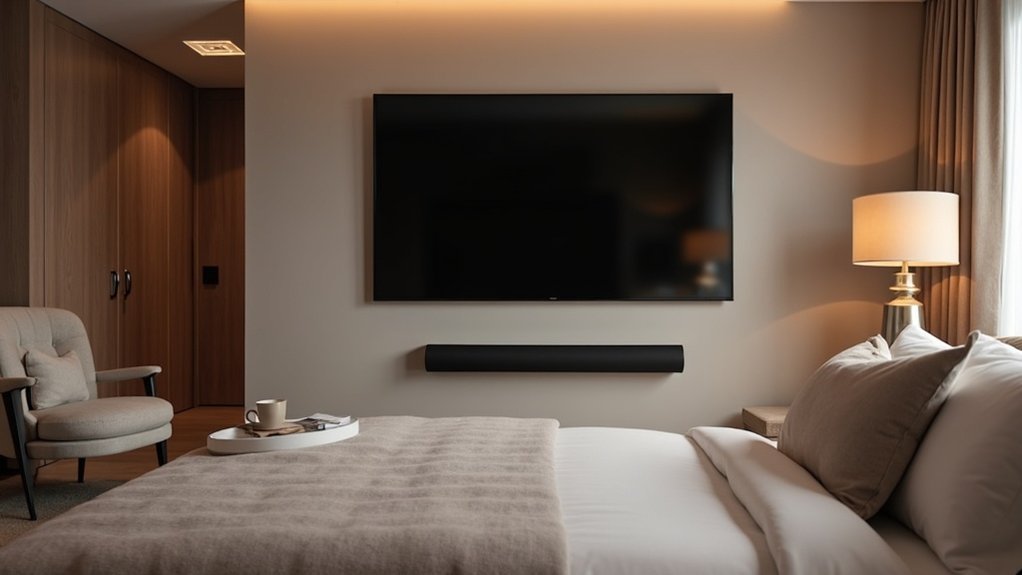
- Proper Positioning: Position the soundbar below the TV for optimal sound projection towards your listening area, ensuring an immersive audio experience.
Furthermore, make sure to clean the speakers periodically and remove any obstructions to facilitate clear audio fidelity.