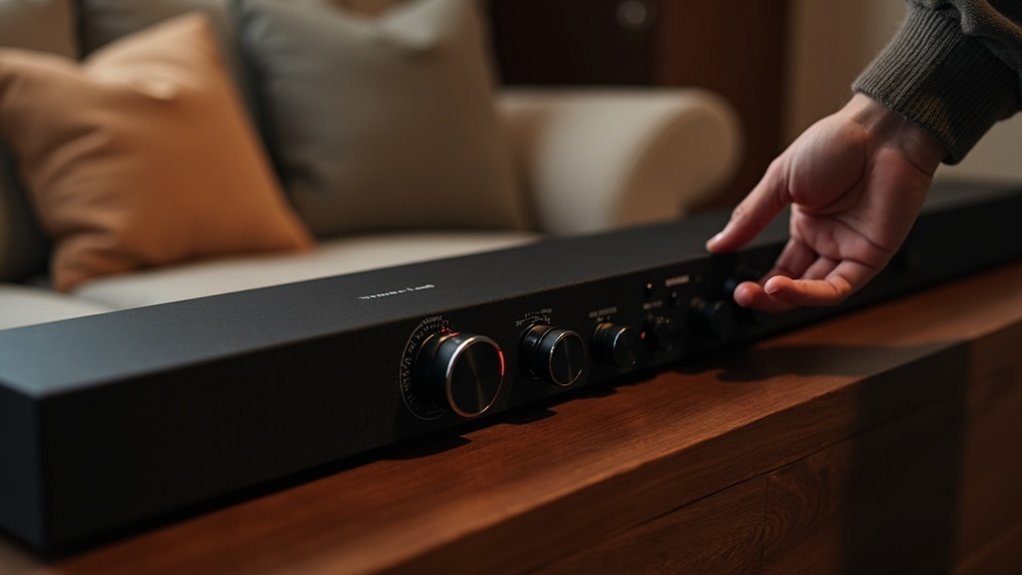
To adjust your soundbar’s crossover to your subwoofer, begin by navigating to the audio settings on your soundbar and setting an initial crossover frequency—around 80 Hz is a solid starting point. Gradually fine-tune this frequency in small increments, paying attention to any bass irregularities that may arise. Afterward, adjust the subwoofer gain to ensure it harmonizes with the soundbar output without dominating the sound. Test various audio tracks to achieve the best results. Continuously monitor and make adjustments according to your preferences, as there are additional techniques that can further enhance your soundbar and subwoofer setup effectively.
Key Takeaways
- Start with a baseline crossover frequency around 80 Hz and adjust based on your soundbar’s capabilities for optimal performance.
- Gradually increase or decrease the crossover frequency in 10 or 20 Hz increments while listening for bass irregularities specific to soundbar audio output.
- Maintain a distance of 3-5 feet between the soundbar and subwoofer to reduce bass cancellation and enhance overall sound clarity, especially for soundbars.
- Ensure the subwoofer gain aligns with the soundbar output level to achieve seamless audio integration without overpowering the main speakers for a cohesive experience.
- Regularly test and document adjustments, considering room acoustics and personal preferences to ensure a balanced audio experience tailored to soundbars.
Understanding Crossover Frequency
Understanding crossover frequency is crucial for optimizing your soundbar’s performance, especially when it comes to balancing low frequencies with your subwoofer.
The crossover frequency marks the point where your soundbar’s speakers roll off low frequencies, typically around 180 Hz for models like the Yamaha YAS-207. A higher crossover setting can muddy vocals and critical audio elements due to a blend of low-frequency sounds.
Additionally, knowing your soundbar’s frequency response is important; smaller models often struggle with low-frequency reproduction.
Experimenting with crossover settings can create a smoother transition between the soundbar and subwoofer, enhancing your overall listening experience. This knowledge is key to getting the most out of your soundbar setup.
Importance of Soundbar and Subwoofer Integration
Integrating your soundbar and subwoofer effectively is essential for achieving the best sound quality in your audio setup.
By carefully adjusting the crossover frequency and experimenting with speaker placements, you can guarantee a seamless audio experience that enhances clarity and immersion.
Addressing these factors helps eliminate localization issues and improves overall performance, ensuring that your soundbar delivers the most impactful audio possible.
Crossover Frequency Impact
When you adjust the crossover frequency of your soundbar and subwoofer, you’re directly influencing the clarity and balance of your audio experience.
Proper subwoofer matching is essential; a well-set crossover frequency guarantees seamless integration of bass, enhancing overall sound quality. For instance, with the Yamaha YAS-207 at 180 Hz, vocal clarity can improve, while the JBL BAR 3.1’s 140-150 Hz setting provides a different balance.
Setting the crossover frequency too high can diminish bass depth, while setting it too low may muddy dialogue.
Experimenting with these settings within your specific environment helps achieve the best sound performance, effectively aligning the strengths of both your soundbar and subwoofer.
Speaker Placement Strategies
Effective speaker placement is critical for optimizing the performance of your soundbar. To achieve a balanced audio experience, consider these strategies:
- Maintain a distance of 3-5 feet between the soundbar and subwoofer to minimize bass cancellation.
- Elevate the soundbar to ear level for improved dialogue clarity, ensuring it integrates well with the overall sound system.
- Experiment with the subwoofer’s placement, such as corner positioning for enhanced bass, while being mindful of potential uneven distribution.
These strategies will help you maximize the sound quality and enhance your home entertainment experience.
Seamless Audio Transition
Achieving a seamless audio transition between your soundbar and subwoofer is essential for an immersive listening experience. To accomplish this, it’s important to set the proper crossover frequency, typically around 80 Hz, to ensure low-frequency sounds blend smoothly.
If your soundbar has specific crossover points, such as the Yamaha YAS-207 at 180 Hz, make sure to adjust accordingly to avoid bass localization issues. Experiment with crossover settings based on your unique soundbar and subwoofer combination, while also considering the acoustics of your room.
Regular adjustments and critical listening will help you identify any bass discrepancies, ultimately leading to a balanced, cohesive sound profile that enhances your overall audio enjoyment.
Accessing Soundbar Audio Settings
To access your soundbar’s audio settings, start by using the remote control or the on-device buttons, which typically lead you to a menu labeled “Audio,” “Sound,” or “Settings.”
Within this menu, you’ll find options for adjusting the “Crossover Frequency” or “Subwoofer Settings,” allowing you to tailor the distribution of low frequencies between the soundbar and subwoofer.
- Locate the “Crossover Frequency” option.
- Adjust settings based on your room acoustics.
- Test different frequencies while playing varied content to achieve the best clarity.
This process ensures your sound experience is balanced and customized to your preferences, enhancing the overall performance of your soundbar.
Setting the Initial Crossover Frequency
After accessing your soundbar’s audio settings, it’s time to set the initial crossover frequency.
Begin by selecting a point around the manufacturer’s recommendation, which usually falls between 80 Hz and 180 Hz. For instance, the Yamaha YAS-207 suggests setting it at about 180 Hz, while the JBL BAR 3.1 typically ranges from 140 to 150 Hz.
Ensure that this frequency is slightly higher than the lowest frequency your soundbar can accurately reproduce, allowing for a seamless blend with your subwoofer.
Listen critically for any bass bumps or localization issues that may arise at this crossover frequency. Make adjustments in increments of 10 or 20 Hz to find the ideal sound balance, enhancing your overall audio experience with your soundbar.
Fine-Tuning the Crossover Frequency
How can you ensure that your soundbar and subwoofer work in harmony? Fine-tuning the crossover frequency is crucial. Follow these steps for optimal results:
- Begin with a baseline crossover frequency set around 80 Hz, but adjust this based on your soundbar’s capabilities and the acoustics of your room.
- If you’re using a JBL BAR 3.1, anticipate a crossover point between 140-150 Hz, as this may influence the clarity of lower frequencies.
- For the Yamaha YAS-207, take note of a 180 Hz crossover setting, which can affect the richness of deep vocal sounds.
Make adjustments in increments of 10 or 20 Hz, listening for any bass irregularities, and fine-tune the subwoofer volume to create a balanced and immersive audio experience with your soundbar.
Adjusting Subwoofer Gain for Balance
Adjusting the subwoofer gain is essential for achieving a balanced audio experience when using a soundbar.
Start with a lower gain setting and carefully increase it while monitoring how it integrates with the overall sound produced by the soundbar.
This process ensures that the bass complements the audio without overpowering it, enhancing your overall listening experience with the soundbar.
Gain Control Importance
While many overlook the soundbar’s gain control, it plays a critical role in achieving a balanced audio experience. Proper adjustments guarantee your soundbar integrates seamlessly with your main audio setup.
Here are three key considerations:
- Start Low: Begin with the gain at a low setting to prevent overpowering the main speakers.
- Gradual Increase: Slowly raise the gain while playing audio, aiming for clarity without distortion.
- Room Acoustics: Final adjustments should consider your room’s acoustics and speaker characteristics.
Finding the right gain setting is essential for optimal sound performance, ideally within the recommended range specified in your soundbar’s manual.
Balancing Subwoofer Levels
Achieving a well-balanced audio experience with your soundbar requires careful attention to its settings. Start by setting the soundbar’s bass level at a low setting, gradually increasing it while monitoring its integration with the overall audio output.
Ideally, aim for a bass level that provides fullness without overwhelming the clarity of dialogue and other sounds. Listen for any boomy audio that indicates the bass is overpowering the overall sound quality.
Use reference tracks with a balanced mix to fine-tune the bass settings, ensuring it complements the overall sound without drawing attention. Regularly test your adjustments to maintain harmony across the audio spectrum and achieve peak performance.
Matching Speaker Output
To ensure your soundbar provides a seamless audio experience, it’s important to align the subwoofer gain with the output level of the main speakers.
Follow these steps for optimal adjustment:
- Begin with a low subwoofer gain and gradually increase it while listening to familiar tracks.
- Utilize test tracks featuring various bass frequencies to fine-tune the gain, ensuring the bass is felt without being localized.
- Keep a record of your final gain settings for future reference, as room acoustics can influence the ideal subwoofer gain.
Listening Tests for Optimal Sound
How can you ensure that your soundbar and subwoofer provide a seamless auditory experience? Conduct listening tests by adjusting the crossover frequency, starting at the manufacturer’s recommended range (140-180 Hz). Focus on the clarity of dialogue and the integration of bass during various scenes. Utilize tracks with a wide range of frequencies to assess the transition between devices. Experiment in increments of 10 Hz, keeping a record of your findings from each session to achieve optimal bass management without any localization issues.
| Crossover Frequency | Dialogue Clarity | Bass Integration |
|---|---|---|
| 140 Hz | Excellent | Smooth |
| 160 Hz | Good | Balanced |
| 180 Hz | Fair | Overwhelming |
Common Mistakes to Avoid
Listening tests can reveal the best crossover frequency for your soundbar setup, but common mistakes can undermine your efforts. Here are three key pitfalls to avoid:
- Setting the Crossover Too High: Frequencies above 150Hz can blur dialog clarity in your soundbar, leading to a lack of definition, particularly in smaller models.
- Ignoring Frequency Response: Failing to match your soundbar and subwoofer’s capabilities can create bass bumps, resulting in an uneven soundstage that detracts from your audio experience.
- Neglecting Speaker Positioning: Improper placement of your soundbar and subwoofer can distort sound quality and lessen the effectiveness of your crossover settings, impacting overall audio performance.
Stay mindful of these factors to ensure an ideal listening experience with your soundbar.