To calibrate your soundbar for bass balance, position it below the TV at ear level, with the subwoofer placed in a corner or against a wall for optimal performance. Begin by setting the subwoofer gain to around 1/4 to 1/3 of its maximum level, making sure it is approximately 10 dB louder than the main speakers for a well-rounded sound experience. Utilize a sound pressure level (SPL) meter for precise measurements, and make adjustments based on readings from pink noise tests. Regularly fine-tune your settings and evaluate your audio setup to ensure it maintains peak performance, while also exploring additional techniques to further enhance your soundbar experience.
Key Takeaways
- Position the subwoofer in a corner or against a wall to enhance bass output during calibration, especially for soundbars.
- Start the subwoofer gain at 1/4 to 1/3 of maximum and adjust until it’s 10 dB louder than the main soundbar speakers.
- Use an SPL meter to measure sound levels and ensure accurate bass calibration specifically for your soundbar setup.
- Play broadband pink noise through the soundbar to assess and adjust the subwoofer gain and crossover settings effectively.
- Regularly reassess and fine-tune settings based on room acoustics and changes in audio sources for optimal soundbar performance.
Understanding the Importance of Bass Balance
While you might enjoy powerful bass from your soundbar, achieving the right balance is essential for an ideal audio experience. Proper bass balance enhances your immersive audio experience by ensuring that low-frequency effects don’t overpower dialogue and mid-range sounds.
A well-calibrated bass level typically requires the subwoofer, if your soundbar has one, to be about 10 dB louder than the main speakers, fostering a seamless blend. Carefully adjusting speaker levels and considering the placement of your soundbar can greatly improve sound quality.
Regular calibration based on your room acoustics and personal preferences guarantees that bass complements your listening environment rather than detracting from it.
Initial Setup and Placement Considerations
To achieve ideal audio performance with your soundbar, you must carefully consider the initial setup and placement.
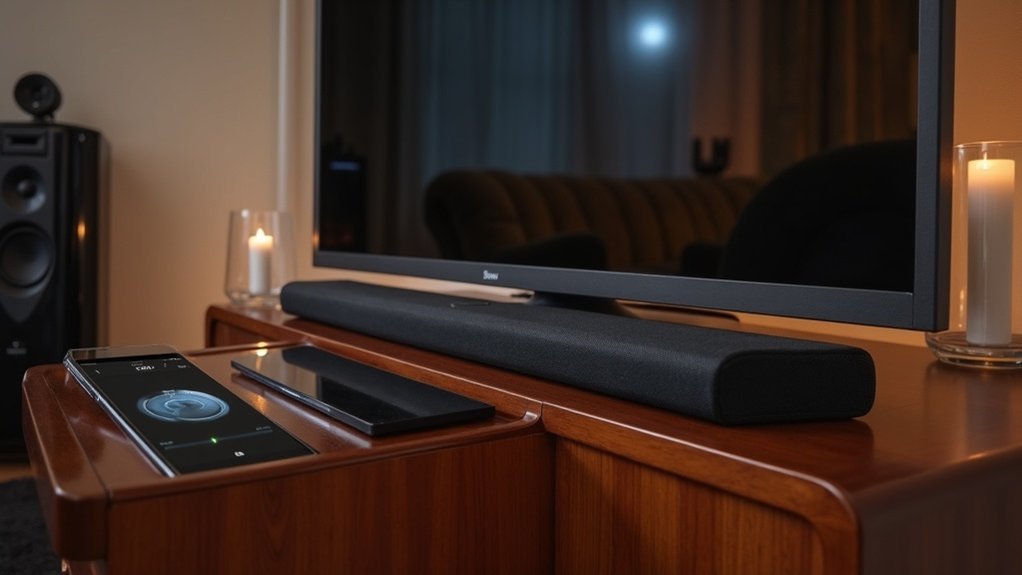
Position the soundbar directly below the TV at ear level to enhance clarity and prevent obstruction of drivers. For subwoofer placement, locate it in a corner or against a wall to improve bass output.
Position your soundbar at ear level beneath the TV for optimal clarity, and place the subwoofer in a corner for enhanced bass.
Avoid enclosing the soundbar in furniture, as this hampers sound quality. Address room acoustics by incorporating soft furnishings to reduce reflections and achieve balanced sound.
Finally, use the crawling test to find the subwoofer’s best sound location, ensuring optimal bass response for your audio experience.
Subwoofer Gain Adjustment Techniques
Proper gain adjustment is essential for achieving ideal bass performance from your soundbar’s integrated subwoofer. Start with the subwoofer gain set between 1/4 to 1/3 of its maximum.
Use calibration tools, like a sound pressure level (SPL) meter, to measure and adjust output, aiming for approximately 10 dB louder than your main speakers for balanced audio.
If your soundbar has an integrated crossover, ensure that the settings complement the overall audio output for seamless frequency blending.
Experiment with the soundbar’s placement in various room locations to enhance low-frequency effects.
Regularly recalibrate and readjust the subwoofer gain as audio sources change to maintain peak sound quality.
Utilizing Pink Noise for Calibration
Calibrating your soundbar’s bass response can significantly enhance your listening experience, and using pink noise is an effective method to achieve an accurate balance.
Begin by downloading a broadband pink noise signal and playing it through your soundbar at a comfortable volume. If you have a subwoofer, integrate it into the calibration process.
Measure the sound pressure level (SPL) with a sound meter, ensuring the subwoofer is about 10 dB louder than the soundbar. Set the meter to C weighting to accurately capture low frequencies.
After adjusting the subwoofer’s gain and crossover settings, fine-tune the levels based on SPL readings to optimize performance. This process can be complemented by the use of acoustic panels to further enhance sound quality.
Measuring Sound Pressure Levels
Measuring sound pressure levels (SPL) is crucial for achieving the best bass balance in your soundbar setup. To ensure optimal performance, use a calibrated SPL meter, ideally set to C weighting, to assess the decibel levels produced by both your soundbar and subwoofer during the calibration process.
Begin by measuring the output of your soundbar, aiming for a baseline target of 60 dB. Once you’ve established that, integrate the subwoofer, adjusting its level to be approximately 10 dB louder, which means targeting around 70 dB overall.
It’s important to take into account the ambient noise level in your room, as it can significantly influence the accuracy of your SPL measurements and enhance your overall sound experience with your soundbar.
Fine-Tuning Audio Settings for Optimal Performance
To achieve ideal audio performance with your soundbar, start by adjusting the bass levels to suit your listening environment and preferences.
Utilize the equalizer settings to refine the sound signature of the soundbar, ensuring clarity across all frequencies.
Finally, test various audio sources connected to the soundbar to identify any discrepancies and make necessary adjustments for a balanced audio experience.
Adjusting Bass Levels
While fine-tuning audio settings for peak performance with your soundbar, adjusting the bass levels of both the soundbar and subwoofer is essential for achieving a balanced listening experience.
Start by setting the subwoofer’s gain to 1/4 or 1/3 according to the manufacturer’s manual. Use a sound pressure level (SPL) meter to ensure the subwoofer is about 10 dB louder than the soundbar.
If your soundbar has a built-in crossover, consider disabling the subwoofer’s crossover for optimal sound. Experiment with subwoofer placement, ideally positioning it in a corner, and use the “crawling test” to find the best low-frequency output.
Utilize pink noise signals to identify discrepancies and make precise bass adjustments for an enhanced audio experience.
Utilizing EQ Settings
Achieving a balanced bass response with your soundbar involves more than just adjusting the subwoofer settings; utilizing the soundbar’s equalizer (EQ) settings is crucial for fine-tuning audio performance.
Start by experimenting with the EQ presets available on your soundbar or create a custom curve tailored to your listening preferences, adjusting the bass level in 2-3 dB increments.
Make use of the soundbar’s calibration feature to optimize EQ settings based on your room’s acoustics, which enhances sound dispersion.
It’s also important to regularly reassess your settings whenever you make changes to your room layout, as these adjustments can affect bass balance and overall sound quality.
This ensures that your soundbar setup remains finely tuned for a variety of content types.
Testing Audio Sources
How can you ensure your soundbar performs at its best with different audio sources? Start by testing various content types like movies, music, and games to understand how your soundbar and subwoofer work together.
Adjust the audio settings according to the specific characteristics of each source by utilizing dedicated sound modes. Use a sound meter to measure the sound pressure level (SPL) from both the soundbar and subwoofer separately, ensuring a balanced sound experience.
When testing, play broadband pink noise, aiming for the subwoofer to be around 10 dB louder than the main speakers for optimal performance.
Regularly revisit and fine-tune these settings based on your personal preferences and the acoustics of your room to achieve the best results.
Tips for Continuous Improvement and Maintenance
To maintain peak performance and ensure your soundbar delivers the best bass response, regularly performing updates and inspections is essential.
Start by checking for software and firmware updates that enhance your soundbar’s performance and unlock new features. Clean the speaker grilles to prevent distortion, ensuring optimal sound quality.
Check for software updates and clean speaker grilles to enhance sound quality and prevent distortion.
Secure all audio connections, as loose cables can disrupt bass balance. Utilize calibration tools to adjust equalizer settings, aligning them with your listening preferences and room acoustics.
Experiment with subwoofer placement every few months to adapt to changing room dynamics. By following these practices, you’ll consistently achieve and maintain exceptional bass performance from your soundbar.